What Is Limerence? Signs, Causes, and Why Anxious Attachment Fuels It
You wake up and they're the first thought. Not a nice thought, exactly. More like a tab that never closes.
You re-read the last text. You check if they viewed your story. You replay the thing they said on Tuesday and try to work out, for the fortieth time, whether it meant something.
Everyone says it's a crush. But a crush doesn't feel like this. This feels like your whole nervous system has been handed to one person, and they don't even know they're holding it.
There's a name for that. It's called limerence, and once you understand what it actually is, a lot of things about your love life start making sense.
What is limerence? The plain-English meaning
Limerence is an involuntary, intense fixation on one person, combined with an overwhelming need for them to feel the same way about you.
The word was coined by psychologist Dorothy Tennov in her 1979 book Love and Limerence. She spent years interviewing hundreds of people about being in love and noticed that some of them described something different from affection or even lust. They described a state that took over: intrusive thoughts, idealization, mood swings tied entirely to the other person's signals, and an ache for reciprocation that nothing else could touch.
She called the person on the receiving end the limerent object, or LO. Not because they're an object, but because in limerence they become more of a screen than a person. You project onto them. You fill in the gaps. The real human and the imagined one blur together.
Three things make limerence different from just liking someone a lot:
- It's involuntary. You don't decide to think about them. The thoughts show up on their own, and pushing them away tends to make them louder.
- It's about reciprocation. The engine isn't "I want to be with them." It's "I need to know they want me." The not-knowing is unbearable.
- It's fed by uncertainty. This is Tennov's central insight, and it's the key to everything that follows. Limerence doesn't grow when someone is clearly into you, and it doesn't grow when they're clearly not. It grows in the gap between the two, where hope and doubt keep trading places.
Limerence is not a diagnosis. It isn't in the DSM, and most people who go through it are not sick. Some researchers, like Wakin and Vo (2008), have argued it deserves clinical attention because of how closely it can resemble dependence and obsessive thinking. But for most of us it's a very human state, and a temporary one.
The signs of limerence
You probably already know if this is you. But here's what it usually looks like day to day.
Intrusive thoughts. They arrive uninvited, dozens of times a day. In the shower, in a meeting, in the middle of a conversation with someone else. Tennov's interviewees described spending the majority of their waking hours thinking about their LO during the peak.
Reading everything as a signal. A one-word reply is a crisis. A heart emoji is a revelation. You analyze their tone, their timing, whether they used a period. Your friends have heard the same screenshot dissected three different ways.
Idealizing them. Their flaws either disappear or become endearing. You've built a version of them in your head that's more available, more interested, and more perfect than the actual person, and you've started relating to that version.
Mood that rises and falls with their attention. They text first and you float for hours. They go quiet and the floor drops out. Nothing in your own life can produce a high or low that big.
Rehearsing and replaying. You script the conversation you'll have. You practice being casual. Afterward, you replay it and grade yourself.
Physical symptoms. Heart pounding when their name shows up. Shaky hands. Trouble eating or sleeping. Butterflies that feel like a sign, but are really just your alarm system.
Checking. Their profile, their story, their last-seen. Who they followed. Whether they liked something. It promises certainty and never delivers it.
Fear of rejection so strong you hide. A strange one, but very common: the more limerent you are, the more likely you are to freeze around them, act cold, or avoid them entirely, because the stakes feel impossibly high.
Everyone else fades. Other people, other interests, even other attractive people stop registering. There's one person and then there's the background.
If you're nodding at most of these, you're not dramatic and you're not broken. You're in a well-documented state that a lot of people go through, usually more than once.
Limerence vs. love vs. a crush
This is where most people get stuck, because limerence feels like the most intense love you've ever experienced. Here's the simplest way to separate them.
A crush is light. You like them, you think about them, it's fun. You can drop it if it goes nowhere. It doesn't run your week.
Love wants closeness and can tolerate space. If they're busy for three days, you miss them, but you're okay. You see the real person, flaws included, and you want them anyway. Love makes your life bigger.
Limerence can't tolerate space. Their silence isn't something you miss, it's something you survive. You're attached to a version of them that lives mostly in your head, and their attention is the only thing that calms you. Limerence makes your life smaller, because everything routes through one person.
Here's the tell: ask what calms you down. In love, the answer is them, and also your friends, your work, a good night's sleep, your own company. In limerence, the answer is only them, and specifically the moments when they seem to want you back.
There's a fuller comparison, including where infatuation and "chemistry" fit, in limerence vs. love: how to tell the difference. And if you want a quick gut check rather than a definition, this 2-minute quiz asks about what you actually do: Is it love or an anxious pattern?
What causes limerence
Two things have to line up.
1. Uncertainty
Tennov was clear on this. Limerence doesn't need a beautiful person or a great story. It needs intermittent reinforcement: a little hope, then a little doubt, then a little hope again.
That's why it so often attaches to people who are hard to read. The coworker who's warm one day and distant the next. The person you're "kind of seeing" who never defines it. The ex who left without closure. Someone who's clearly unavailable but occasionally, unpredictably, isn't.
A person who's consistently into you doesn't trigger this. Neither does a person who's consistently not. It's the slot machine that gets you, and the slot machine is the mixed signal.
2. A nervous system that treats uncertainty as danger
This is the part most articles about limerence leave out, and it's the part that explains why some people fall into it over and over while others barely experience it at all.
Why anxious attachment fuels limerence
If you have an anxious attachment style, your nervous system learned early that closeness could disappear, and that you'd better stay alert for the signs. So when someone you're drawn to sends a mixed signal, your body doesn't read "give it time." It reads threat.
And the fastest way to make a threat go away is to get the person to choose you.
That's the whole loop. Uncertainty spikes your alarm. Their attention quiets it. Their withdrawal spikes it again. Before long, your brain has learned that this one person is the on/off switch for your anxiety, and it will do what brains do with switches: reach for it constantly.
The research backs this up. In one of the earliest studies to look at it directly, Feeney and Noller (1990) measured attachment style alongside limerence, "mania" (an obsessive, possessive love style), and love addiction in 374 young adults. The anxious-ambivalent group scored highest on all three. People with avoidant attachment reported less desire for deep commitment. Secure people sat in the middle: they loved, but they didn't obsess.
A small qualitative study by Willmott and Bentley (2015) found the same thread from the inside. Their limerent participants described ruminative thinking, a free-floating anxiety that latched onto one person, and a sense of losing themselves, and the authors tied the pattern to underlying attachment anxieties and unresolved earlier experiences.
So when people say "limerence is just anxious attachment," they're oversimplifying, but they're not wrong. Limerence is what anxious attachment feels like at full volume. It's the acute version. The everyday anxious pattern, checking, seeking reassurance, over-reading, gets pointed at one person and cranked all the way up.
This matters because it changes what "getting over it" means. If limerence were just about this one person, you'd get over them and be fine. But if it's your attachment system doing what it always does, the next hard-to-read person will trigger the same thing. Which is probably why this isn't your first time.
What about avoidant and fearful-avoidant people?
They get limerent too, but it tends to look different. An avoidant person is more likely to fixate on someone from a distance, on someone unavailable, or on an ex, precisely because distance keeps it safe. A fearful-avoidant (disorganized) person can swing between anxious pursuit and shutting down entirely, which produces a particularly exhausting version. But the highest-intensity, most persistent limerence shows up most reliably in the anxious pattern.
Limerence inside a relationship
A common misconception is that limerence only happens with someone you can't have. It doesn't.
Limerence runs inside relationships all the time, and it runs hottest with a partner who is warm and then withdrawn. If you're anxious and your partner is avoidant, you're living in the exact uncertainty Tennov described, and you may have spent months or years in a low-grade limerent state without a name for it. Every pull-back reignites the fixation. Every return floods you with relief that feels like love.
That's the anxious-avoidant trap, and it's worth knowing that the intensity you feel isn't proof the relationship is right. Often it's proof that it's unpredictable.
And after that kind of relationship ends, especially without closure, the limerence tends to spike rather than fade. We wrote about that specific situation here: limerence for an avoidant ex.
How long does limerence last?
Tennov's estimate, from her interviews, was that a typical episode runs somewhere between 18 months and three years. The short end was a few weeks. The long end, in a handful of cases where uncertainty never resolved, was decades.
That's a wide range, and the reason it's wide is that limerence doesn't run on a clock. It runs on uncertainty. It lasts as long as the hope-doubt cycle keeps spinning, which is why "just wait it out" works for some people and fails completely for others.
It ends in one of three ways:
- Certainty, in either direction. They clearly want you, and the fixation gradually turns into an ordinary relationship (or, sometimes, fizzles once the mystery is gone). Or they clearly don't, and with no new hope to feed on, it slowly starves.
- Transfer. Your attention lands on someone new. This is common and not especially healthy, because it usually means the pattern is intact and just has a new target.
- Starvation. You cut off the intermittent reinforcement yourself: no checking, no contact, no re-reading. This is the hard route and the one most within your control.
More on the timeline, and what speeds it up or drags it out, in how long does limerence last.
How to stop limerence (the short version)
The full step-by-step is here: how to stop limerence. The short version follows directly from everything above.
Cut the uncertainty inputs. Every check, every re-read, every "just looking" at their profile is a pull of the slot machine. You can't stop the thoughts by force, but you can stop feeding them. Mute, unfollow, archive the thread. Not as punishment, as starvation.
Soothe the body before you act. The urge to text, check, or seek reassurance is an alarm, not information. Slow breathing, a walk, a cold glass of water, five minutes of writing. Then decide. Acting from the spike is what keeps the loop alive.
Get certainty if you can, then respect it. Sometimes the kindest thing you can do for yourself is ask directly and accept the answer, including a no. A clear no hurts for a while. An endless maybe hurts for years.
Build a life that isn't routed through them. Limerence shrinks your world to one person. Widen it on purpose: people, work, movement, anything that gives you a mood that isn't dependent on their next message.
Work on the pattern, not just the person. If this is your anxious attachment at full volume, the real project is turning the volume down in general. That's slower and less dramatic than getting over one person, and it's the only version that keeps the next hard-to-read person from doing the same thing. If you're not sure what your pattern is, the attachment style quiz is a good starting point.
Know when to get help. If limerence is costing you sleep for weeks, wrecking your focus at work, or straining a relationship you're already in, talk to a therapist. It's a real state with real effects, and you don't have to white-knuckle it alone.
Limerence isn't a character flaw
One last thing, because it matters.
People who experience limerence are usually people who feel deeply, love hard, and pay close attention. Those are good qualities. The problem isn't that you care too much. It's that your alarm system is wired to a person instead of to reality, and it's been that way since long before this particular person showed up.
Understanding that doesn't make the thoughts stop tomorrow. But it does change the question from "what's wrong with me" to "what is my attachment system trying to do," and that second question has answers.
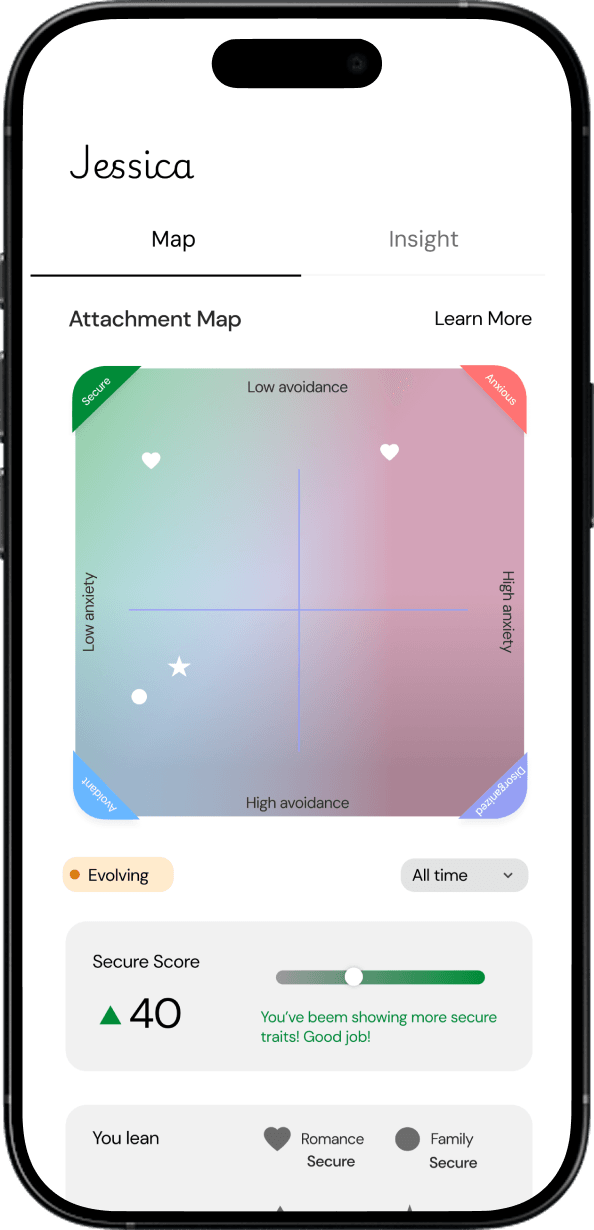
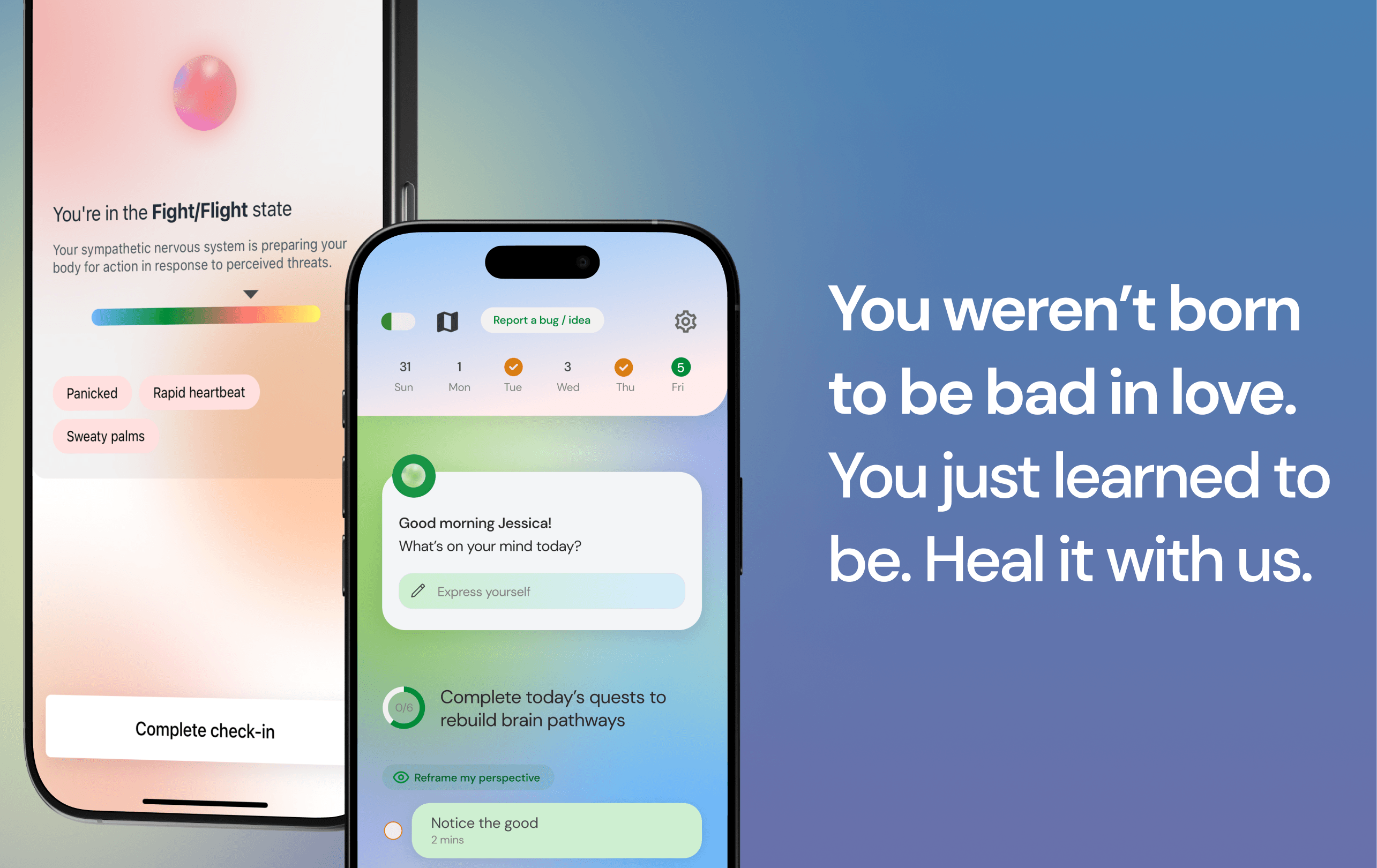
Attached is built for exactly that. Learn about your attachment patterns, explore your emotions through guided journaling, and continue with personalized reflection prompts, meditations, and exercises based on what you actually write down at 2am. Start with the attachment style quiz, and you'll get a plan for your pattern rather than a label for it.
Sources: Tennov, D. (1979). Love and Limerence: The Experience of Being in Love. Feeney & Noller (1990), Journal of Personality and Social Psychology. Wakin & Vo (2008), Love-Variant: The Wakin-Vo I.D.R. Model of Limerence. Willmott & Bentley (2015), The Qualitative Report.
Frequently asked questions
What is limerence in simple terms?
Limerence is being hooked on one person and on the question of whether they like you back. You can't stop thinking about them, you read meaning into everything they do, and your mood rises and falls with their attention. It feels like intense love, but it's driven by uncertainty rather than closeness.
Is limerence the same as love?
No. Love can tolerate space and not-knowing; limerence can't. In limerence, the other person's attention is the only thing that calms your anxiety, so your mind loops back to them constantly. Love tends to feel expansive and steady. Limerence feels like a compulsion with a euphoric edge.
Is limerence a mental illness?
No. Limerence is not a diagnosis and does not appear in the DSM. Some researchers have proposed it as a clinical concept because of its overlap with obsessive thinking and dependence, but for most people it's an intense, temporary state, not a disorder. If it's disrupting your sleep, work, or relationship, a therapist can help.
What causes limerence?
Uncertainty is the fuel. Limerence tends to ignite when someone attractive to you sends mixed signals, so hope and doubt alternate. Attachment style matters too: research finds anxious attachment scores highest on limerence, because an anxious nervous system reads not-knowing as danger and fixates on the person who could end it.
How long does limerence last?
Tennov's estimate from her interviews was that a typical episode lasts roughly 18 months to three years, with extremes from a few weeks to many years. It usually ends one of three ways: the feelings are clearly returned and settle into an ordinary bond, they're clearly not returned and starve, or your attention moves to someone new.
Can you have limerence for someone you're dating?
Yes. Limerence isn't only about unrequited crushes. It can run inside a relationship whenever reciprocation feels uncertain, which is common with a hot-and-cold or avoidant partner. The mixed signals keep the hope-doubt cycle going, so the fixation never gets a chance to settle.

Related articles
More reading to help this topic connect across the blog.
It feels like the biggest love of your life. So why does it only feel good when they text back? Here's how to tell limerence from love, and infatuation from both.
You've read the same text forty times. You check if they viewed your story. Here's how to stop limerence step by step, and why anxious attachment keeps the loop running.
You want a number. The honest answer is 18 months to 3 years on average — but the timeline depends much less on the calendar than on how much uncertainty you're still feeding it.
Anxious-avoidant attachment is the draining loop where one person reaches for closeness and the other reaches for space, and each move makes the other's fear worse. This guide covers the psychology behind it and what actually helps you change it.
Understand your attachment style
Read the full guide to each attachment style, or take the quiz to find yours.