Butterflies in Your Stomach Isn’t a Sign of Chemistry

“She sees him across the room. They lock eyes for a moment and her breath catches. Her stomach starts bursting with butterflies, the kind where two strangers lock eyes over a cup of coffee and destiny does the rest.”
Hollywood, Korean dramas and romance novels have been selling us the same formula for years.
Butterflies mean love at first sight.
Passion mean chemistry.
Will-they-or-won’t-they mean destiny.
But what if this entire billion-dollar formula is based on a lie our bodies tell us?
I have a problem with Hollywood, Korean dramas and romance novels because they’ve misled millions of women into what love means, and what isn’t.
What butterflies in your stomach really means
It’s a stress response.
When your stomach flutters and drops, it’s your nervous system lighting up.
Adrenaline and norepinephrine is spiking through your gut, and your gut-brain axis begins to prepare you for uncertainty (Feldman, 2017; Porges, 2011).
This was your body screaming to you, “Hey… uhhh… something unpredictable is happening and I don’t like it!”
We only thought “this is love at first sight” because unpredictability feels thrilling.
It feels cinematic. Like the stories we grew up watching.
We think it’s love, or us finding our soulmate, because no one taught us the difference.
Butterflies in your stomach doesn’t mean love. It means biology is at work.
Around ~50% of us are insecurely attached (anxious, avoidant, fearful-avoidant).
Your brain develops a blueprint for love based on how you were loved:
- If your caregiver was inconsistent, you learned to crave the high-low rollercoaster
- If your caregiver was emotionally distant, you learned to chase people who pull away
- If your caregiver was chaotic, your nervous system thinks chaos means connection
So when someone feels unpredictable:
- Mixed signals
- Mysterious
- Hot-cold
Your system lights up.
Your stomach “butterflies”
Your brain interprets the alarm as desire
Because the feeling is familiar, and it mirrors your past.
And because your attachment system wakes up faster than your logic does.
Insecure attachment doesn’t point you toward who’s good for you. It points you toward who feels familiar.
Anxious attachment and butterflies
Studies show that anxious attachment is strongly linked to heightened physiological stress responses, including the exact gut sensations we call “butterflies.”
S. K. Nielsen et al. (2017) found that attachment anxiety correlates with emotion dysregulation, which often shows up physically: tight stomach, nausea, fluttering.
H. Şahan et al. (2018) showed that people with functional dyspepsia and anxious attachment report significantly higher trait anxiety than other groups.
A. Oskis et al. (2011) found that those anxiously attached have elevated cortisol and altered stress responses, which directly influence gut sensations.
And G. Norton et al. (1999) showed that over half of people under psychological distress also experience functional gastrointestinal symptoms.
No study says “butterflies = insecure attachment.”
This effect doesn’t show up in every situation, because misreading arousal as attraction really depends on the context.
But the pattern is here:
Your stomach reacts to uncertainty. Your brain labels it romance. Hollywood sells it as destiny.
So what does secure love feel like?
The plot twist Hollywood never shows:
Secure love is calm. Secure love is steady. Secure love feels almost… boring at first.
Your stomach doesn’t drop.
Your heart doesn’t race.
Your brain doesn’t perform Olympic-level gymnastics after every interaction.
Your body relaxes instead of bracing.
Secure love doesn’t always start with butterflies.
It starts with consistency.
It starts with clarity.
It starts with someone who doesn’t activate your wounds on day one.
The real “spark” isn’t the stomach flip.
It’s the moment your nervous system realizes it can rest.
Why I built Attached
Because I spent years thinking anxiety means chemistry.
I grew up with emotionally immature parents.
No one showed me what calm intimacy looked like.
No one taught me repair, safety, or stable connection.
So I kept chased the wrong people.
I found myself attracted to avoidant partners.
I thought the butterflies meant love, when they only meant my attachment wounds recognized something familiar.
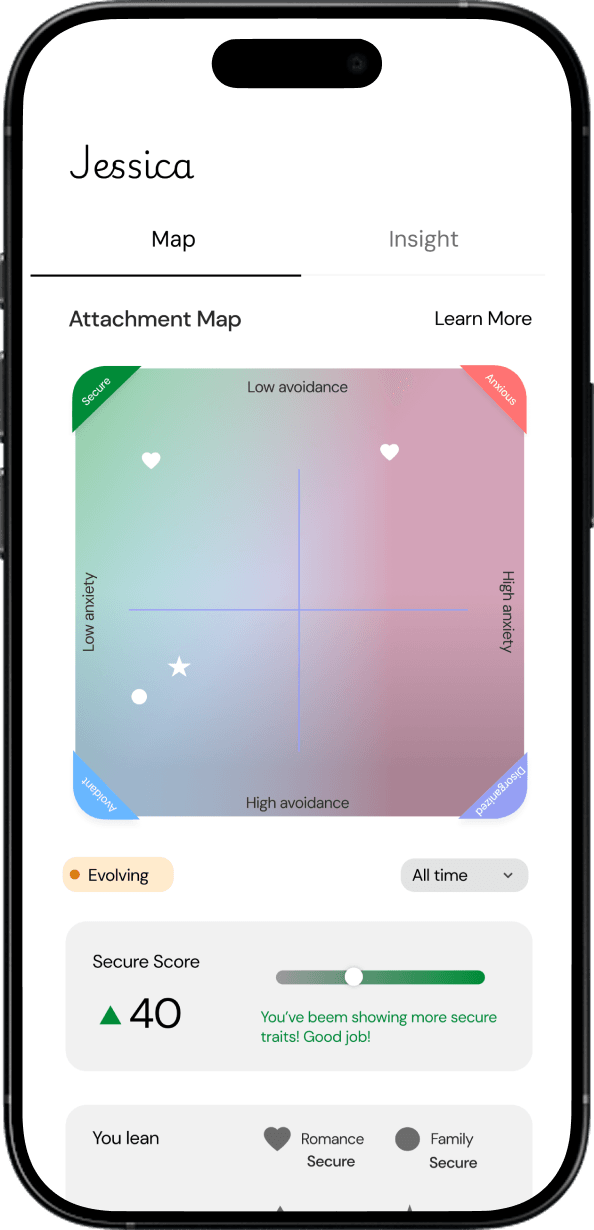
Attached exists because I needed a map.
A way back to myself.
And now it’s a way back for anyone who grew up the way I did.
The app to help you understand your patterns and feel better immediately
Love shouldn’t feel like chasing someone who keeps walking away.
Attached is the No. 1 app that helps you explore your relationships and attachment style, so you can stop repeating old patterns and finally manage your insecure attachment.
The app includes:
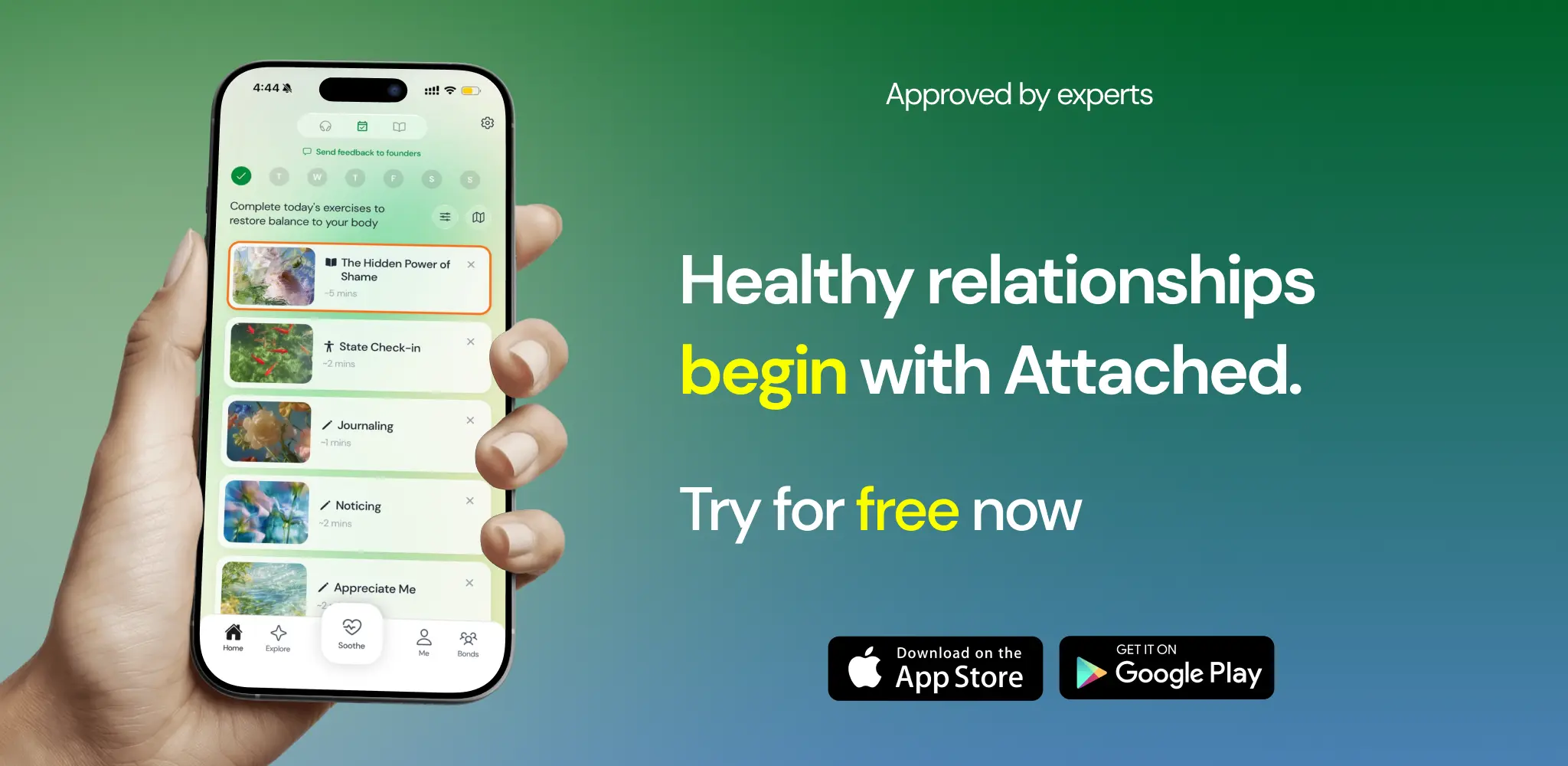
- Daily Exercises to rewire your attachment habits
- Self-Soothe Mode for the moments you feel triggered
- Journal prompts to uncover the stories keeping you stuck
- Weekly insights from Eden, your relationship guide
Download Attached for free and start building the calm, steady, secure love story you actually deserve.
Sources
- Allen, J. B., Kenrick, D. T., Linder, D. E., & McCall, M. A. (1989). Arousal and attraction: Evidence from self-report and psychophysiology. Journal of Personality and Social Psychology.
- Foster, C. A., Witcher, B. S., Campbell, W. K., & Green, J. D. (1998). Arousal and attraction: Evidence for automatic and controlled processes. Journal of Personality and Social Psychology.
- Dutton, D. G., & Aron, A. P. (1974; replicated 1989). Some evidence for heightened sexual attraction under conditions of high anxiety. Journal of Personality and Social Psychology.
- Kenrick, D. T., Cialdini, R. B., & Linder, D. E. (1979). A failure to replicate the misattribution of arousal effect. Journal of Personality and Social Psychology.
- Porges, S. W. (2011; foundational work 1998). Polyvagal theory and autonomic stress responses. Psychophysiology.
- Feldman, R. (2017). Biobehavioral synchrony and the stress response in relationships. Current Opinion in Psychology.
Related articles
More reading to help this topic connect across the blog.
The horror hit Obsession (2025) is really a story about wanting someone to love you back. Here's what it reveals about anxious attachment, limerence, and the line between love and obsession.
If Taylor Swift's lyrics hit a little too close to home, you're not alone. New research suggests the songs we love might mirror—and even reinforce—our attachment patterns.
What if Taylor Swift’s “type” didn’t change by accident… but because of something else? And why Travis Kelce might be different to the rest.
Which is the better app for insecure attachment? Anxious, avoidant, disorganized, fearful-avoidant.
Understand your attachment style
Read the full guide to each attachment style, or take the quiz to find yours.