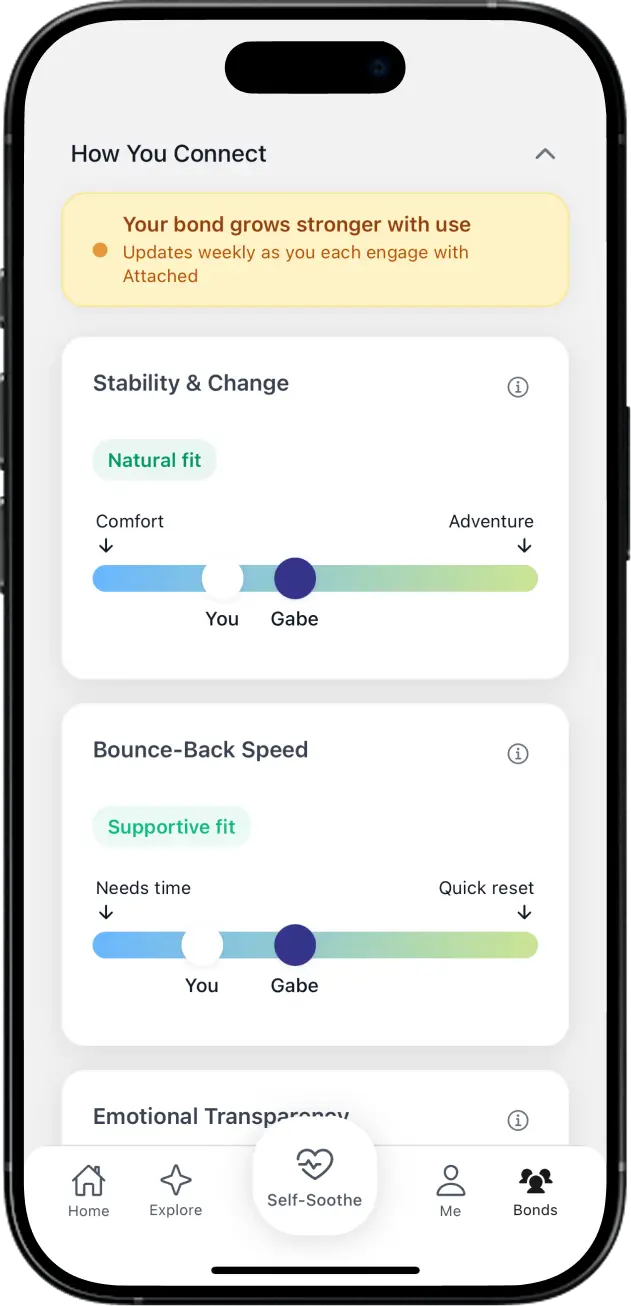
Find your attachment style today. Discover your unique relationship blueprint with a partner
Fearful Avoidant Attachment: What It Is, Why It Happens, and How to Heal

What the data shows: In Attached's analysis of 11,793 people working on their attachment, fearful-avoidant patterns were among the most common in this help-seeking community — and consistent journaling practice was associated with measurable drops in attachment anxiety over time. See the State of Attachment research →
Come Here. No, Wait — Go Away.
You meet someone. It's good. Really good.
And then, right on schedule, the alarm goes off. You find a flaw. You pick a fight. You go quiet. You do the thing you swore you wouldn't do this time.
Then they pull back — and suddenly all you want is for them to come close again.
If love feels like a door you keep opening and slamming, this is your guide. That's fearful avoidant attachment.
What Is Fearful Avoidant Attachment?
Fearful avoidant attachment is the insecure attachment style that runs two programs at once:
- The anxious program: get close, don't lose them, closeness = safety
- The avoidant program: protect yourself, don't depend, closeness = danger
Most attachment styles pick a lane. Fearful avoidants live in the merge.
In the research literature this pattern is often called disorganized attachment — the terms describe the same push-pull dynamic. We keep a separate in-depth guide to disorganized attachment, including its childhood roots; this page focuses on how the fearful avoidant pattern shows up in adult love, and what to do about it.
The signature experience: "I want you. And you scare me. And I can't tell which feeling to trust."
Signs of Fearful Avoidant Attachment in Adults
You might be fearful avoidant if:
- You idealize someone hard in the beginning, then feel trapped once they're actually available
- You test partners — pulling away to see if they'll chase, withholding to see if they'll notice
- Your relationships feel like weather systems: intense closeness, sudden cold fronts
- You can go from "you're my whole world" to "I need to get out of this" within a day
- You struggle to trust kindness; part of you keeps waiting for the catch
- After you push someone away, you feel intense longing — for the exact person you just pushed
- You feel emotions at full volume, then flip into numbness like a breaker tripping
Sound like someone who's both anxious and avoidant? That's exactly what this style is. The free attachment style quiz can tell you where you actually land in 5 minutes.
The Push-Pull Cycle
The fearful avoidant loop usually runs like this:
- Pursue. Someone feels safe and exciting. You move toward them, often fast.
- Panic. Real intimacy arrives. Your nervous system reads it as exposure, not comfort.
- Push. You create distance — criticism, a fight, silence, a sudden need for space.
- Grieve. Distance achieved, the anxious program comes back online. You miss them desperately.
- Pull. You reach out, repair, reconnect... and the cycle arms itself again.
Neither move is random. Both are protection. Your system learned that closeness is precious and dangerous, so it alternates between reaching for it and defending against it.
Fearful Avoidant vs. Dismissive Avoidant
The two avoidant styles get confused constantly. The difference is what happens inside when distance opens up:
- A dismissive avoidant feels relief. Attachment volume: turned down. Distance is comfortable, and they rarely chase after a breakup.
- A fearful avoidant feels relief for about a day — then longing, doubt, and the urge to reach back out. Attachment volume: cranked up and down unpredictably.
Dismissive avoidants deactivate. Fearful avoidants oscillate.
Other tells: dismissive avoidants tend to have stable, low-drama relationship histories that end quietly; fearful avoidant histories tend to be intense, stormy, on-again-off-again. Dismissive avoidants mostly fear being controlled or engulfed; fearful avoidants fear engulfment and abandonment at the same time.
If the dismissive description fits better, read the dismissive avoidant guide.
Where It Comes From
Fearful avoidant attachment usually develops when the people a child depended on were also, at times, the people who frightened, overwhelmed, or deeply disappointed them.
That can mean frightening or chaotic caregiving, a parent who ran hot and cold — warm one day, harsh or absent the next — or growing up around conflict, unpredictability, or loss that no one helped you make sense of.
The child's dilemma is impossible: the person I need for comfort is the person I need protection from. The nervous system solves it the only way it can — by keeping both programs running. Reach and brace. Love and scan for danger.
Nothing about that is your fault. It was an intelligent answer to a confusing environment. It's just costing you now.
Fearful Avoidant in Relationships
This style tends to produce the most intense relationships of any attachment pattern — for both people:
- Chemistry that feels fated in the beginning (intensity reads as connection)
- Partners who feel whiplashed: adored, then shut out, then pursued again
- Jealousy and trust struggles even in objectively safe relationships
- Breakups and reunions, sometimes several rounds of them
- A deep fear, usually unspoken: if you really saw me, you'd leave
With an anxious partner, the fearful avoidant's withdrawal triggers panic and pursuit. With a dismissive avoidant partner, both people can drift into a distant standoff no one knows how to end. With a secure partner — and this is the hopeful part — the storms tend to shrink, because the testing meets steadiness instead of escalation.
Triggers That Set Off the Cycle
Common fearful avoidant triggers:
- A partner getting more loving (intimacy = alarm)
- Feeling dependent on someone, or noticing they depend on you
- Ambiguity — texts left on read, unclear plans, mixed signals
- Conflict, even mild, that has no quick resolution
- Big commitment steps: moving in, meeting family, defining the relationship
Knowing your triggers doesn't stop them from firing. But it turns "I'm suddenly desperate to escape this relationship" into "my alarm went off" — which is a very different problem to solve.
How to Heal Fearful Avoidant Attachment
Healing this pattern is about teaching your nervous system a sentence it's never fully believed: closeness and safety can be the same thing.
- Learn your loop. Track the cycle — pursue, panic, push, grieve, pull. Journaling after each swing builds the map your reactions never gave you.
- Slow everything down. Fearful avoidant chemistry burns fast. Slower pacing gives your alarm system fewer false positives.
- Say the pattern out loud. "I pull away when I get scared — it's not about you" is the single highest-leverage sentence for this style. It recruits your partner instead of making them the enemy.
- Ride the wave without acting. When the urge to flee (or chase) spikes, wait 24 hours before big moves. The feeling crests and falls. Decisions made mid-spike are the ones you undo later.
- Regulate the body, not just the thoughts. This pattern lives in the nervous system. Breathwork, movement, and guided meditations lower the baseline so triggers have less to grab.
- Get support that's built for this. Therapy or coaching helps many people. For daily structure, Attached offers guided journaling, meditations, and exercises designed around attachment patterns — the daily reps between the big conversations.
Self-Reflection Prompts
- When I push someone away, what am I hoping they'll do?
- What did closeness cost me growing up — and am I still paying that bill in relationships where it's free?
- Which relationship felt safest to me, and what did that person do differently?
Common Questions
FAQ
Do I have to be in a relationship to use this app? Can I use it alone?
Who's Eden the relationship coach from Attached?
I've tried talk therapy before but it hasn't helped, how is Attached any different?
- Online talk therapy: Many online therapists on general platforms may not specialize in attachment-based issues.
- Attached: Built around attachment patterns, guided reflection, and relationship habits, our tools help you notice the patterns behind relationship stress and practice different responses.
- Online talk therapy: Many platforms match you randomly with a therapist who may not have deep attachment expertise.
- Attached: Backed by experts in attachment; we designed the app around relationship reflection, attachment education, and daily practice.
- Online talk therapy: Providers may not remember every detail between sessions.
- Attached: Eden remembers and adapts to your journey.
- Online talk therapy: Limited hours of availability.
- Attached: 24/7 access so you can manage triggers and exercises anytime.
How is Attached different to ChatGPT?
- ChatGPT: General purpose AI assistant.
- Attached: Built for attachment patterns, self-reflection, and relationship habits.
- ChatGPT: Answers general inquiries.
- Attached: Uses psychology-informed prompts to help you reflect, slow down, and choose your next step.
- Bite-sized lessons based on relationship science
- Eden, your coach, grounded in relationship psychology
- Personalized meditations
- Accountability via gamification
How is attachment related to my interpersonal problems?
Does this still help if I'm currently in therapy?
Do I need to give a credit card to start the trial?
Is my data safe?
Can I use Attached for all attachment styles?
I don't have insecure attachment. Can I use Attached for general wellness?
The Hope
Fearful avoidants often believe they're "too much and not enough at the same time." You're neither. You're someone whose alarm system got wired in a place where love and fear shared a room.
The wiring can change. Not overnight, and not by finding the one magical person who never triggers you — but through reps: noticing the loop, naming it, riding the spike, choosing differently one swing at a time.
People with this pattern who do the work don't just get calmer relationships. They keep the depth and lose the whiplash.
Find out where you're starting from: take the attachment style quiz.
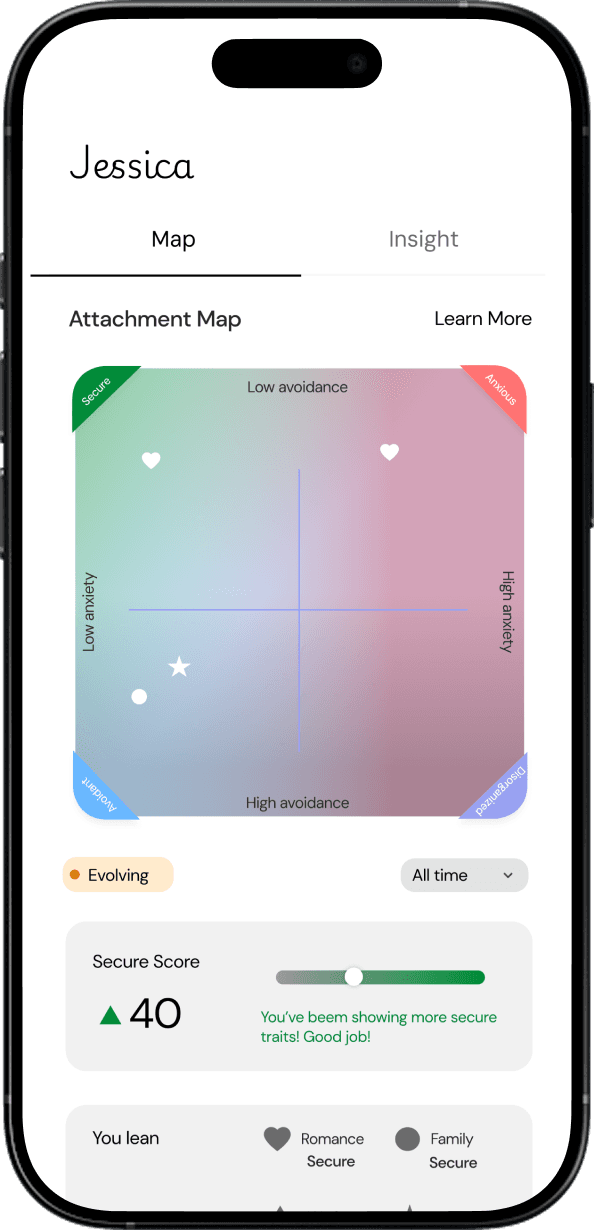
Discover your attachment style now and get a personalized plan
Attached is changing thousands of lives
Even in therapy, I struggled to be fully honest, mostly out of embarrassment over irrational thoughts. But this app made it safe. The app's slow, intentional pacing helped me absorb the lessons and reflect on how they apply to my life. The Trigger Cards were a game-changer—custom to my real triggers and guide me in the moment. I've started recognizing how my anxious attachment shows up and blocks me from fully experiencing love.
I'm very grateful for this app as it has been helping me understand myself and my patterns, encouraging growth through self-compassionate journaling, reflection, and habit tracking. My favorite part is the personalized meditations created uniquely for me.
After my divorce and the death of my best friend and mother, I struggled to adapt. I've been in therapy for years and this app is an incredible tool to help me practice the things my therapist recommends. The journaling tool reframes thoughts using AI, and the meditation feature guides acceptance, breathing, and grounding techniques.
This app is beyond helpful. It simplifies your journey through lessons, guided meditations, and journal prompts. It keeps you on track and maps your progress. It's worth the investment and I'm so glad I found it!
Even in therapy, I struggled to be fully honest, mostly out of embarrassment over irrational thoughts. But this app made it safe. The app's slow, intentional pacing helped me absorb the lessons and reflect on how they apply to my life. The Trigger Cards were a game-changer—custom to my real triggers and guide me in the moment. I've started recognizing how my anxious attachment shows up and blocks me from fully experiencing love.
I'm very grateful for this app as it has been helping me understand myself and my patterns, encouraging growth through self-compassionate journaling, reflection, and habit tracking. My favorite part is the personalized meditations created uniquely for me.
After my divorce and the death of my best friend and mother, I struggled to adapt. I've been in therapy for years and this app is an incredible tool to help me practice the things my therapist recommends. The journaling tool reframes thoughts using AI, and the meditation feature guides acceptance, breathing, and grounding techniques.
This app is beyond helpful. It simplifies your journey through lessons, guided meditations, and journal prompts. It keeps you on track and maps your progress. It's worth the investment and I'm so glad I found it!
Start with a free week on us, no credit card needed.
After free week
What could cost you $7,600/year is now $156/year
No credit card to start
FAQ
Do I have to be in a relationship to use this app? Can I use it alone?
Who's Eden the relationship coach from Attached?
I've tried talk therapy before but it hasn't helped, how is Attached any different?
- Online talk therapy: Many online therapists on general platforms may not specialize in attachment-based issues.
- Attached: Built around attachment patterns, guided reflection, and relationship habits, our tools help you notice the patterns behind relationship stress and practice different responses.
- Online talk therapy: Many platforms match you randomly with a therapist who may not have deep attachment expertise.
- Attached: Backed by experts in attachment; we designed the app around relationship reflection, attachment education, and daily practice.
- Online talk therapy: Providers may not remember every detail between sessions.
- Attached: Eden remembers and adapts to your journey.
- Online talk therapy: Limited hours of availability.
- Attached: 24/7 access so you can manage triggers and exercises anytime.
How is Attached different to ChatGPT?
- ChatGPT: General purpose AI assistant.
- Attached: Built for attachment patterns, self-reflection, and relationship habits.
- ChatGPT: Answers general inquiries.
- Attached: Uses psychology-informed prompts to help you reflect, slow down, and choose your next step.
- Bite-sized lessons based on relationship science
- Eden, your coach, grounded in relationship psychology
- Personalized meditations
- Accountability via gamification