Attached vs. Paired: Which App Is Better for Fixing Your Relationship?
I once watched a friend refresh her texts for forty minutes while sitting across from me at dinner. Her boyfriend had left her on read. She wasn't rude about it — she just kept picking up her phone, putting it down, picking it up again. The food went cold. She barely noticed.
That's an anxious attachment system doing its job. A job it learned years before she ever met him.
The question is — what do you actually do with that? There are two apps a lot of people land on when they start asking that question.
If you are trying to repair a relationship — or just stop repeating the same painful loop — you have probably come across Attached App and Paired.
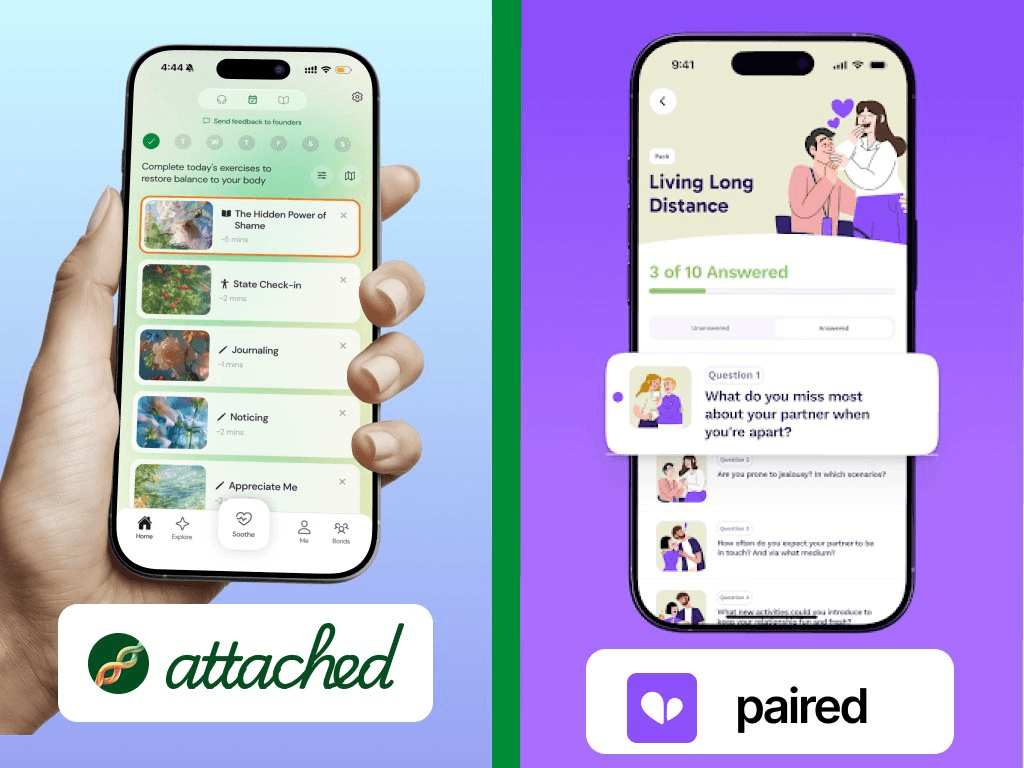
Both are well-made. Both have real research behind them. But one is built for the work you do inside yourself. The other is built for the work two people do together. That difference matters more than any feature list. Here's the full picture.
Attached App: Built for the True Root Cause
Most relationship problems are not really about the dishes. Or the text that never came.
They are about attachment — the way your nervous system learned to stay safe in relationships when you were very young. Long before you had the words for it. Long before you knew there was a word for it.
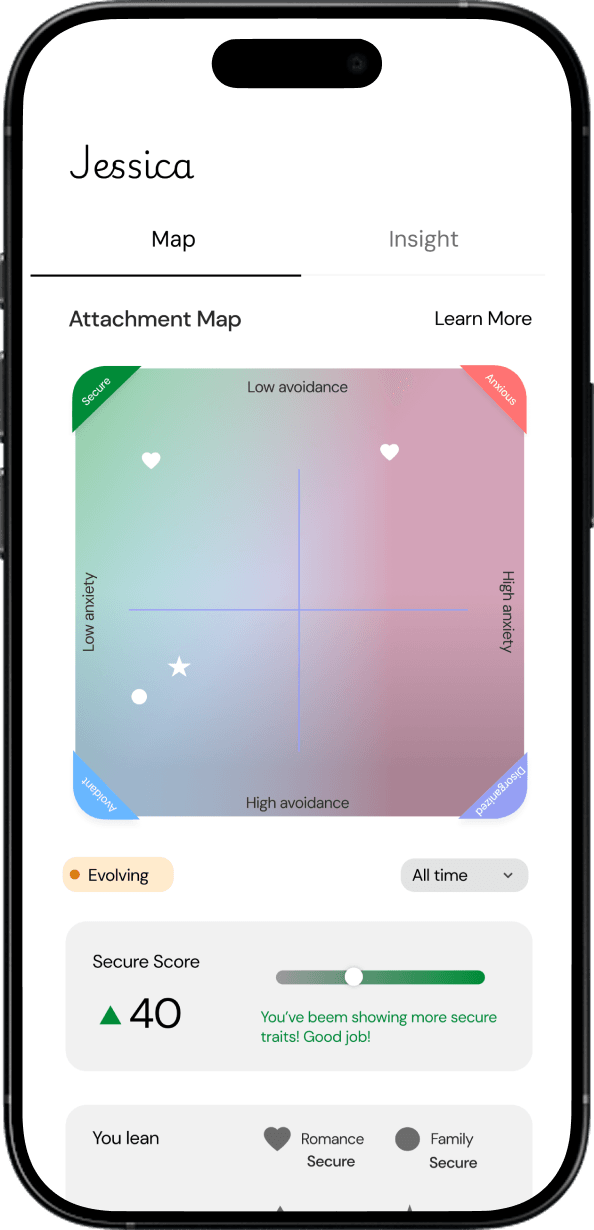
There's a body of research — started by a British psychiatrist named Bowlby in the 1950s, kept going by decades of studies after him — that basically says: the way you attach to people as an adult is a direct echo of what felt safe when you were small. Four patterns emerged from all that research. Secure, anxious, avoidant, fearful-avoidant. Most people, when they first read the descriptions, go very quiet.
Knowing which one you are does not automatically fix anything. I want to be honest about that. But it changes the question you are asking. Instead of "why do I always do this" you start asking "what is my nervous system trying to avoid."
Attached App is built entirely on this science. It helps you see your attachment style, recognize your triggers, and slowly rewire how you respond — whether your partner is on board or not. If you want to start right now, the free attachment style quiz takes about three minutes and tells you exactly where you land.
Your partner goes quiet after an argument. For someone with a secure attachment style, that silence is just… silence.
For someone with anxious attachment, the same silence triggers a full alarm. Your brain fills the gap with stories. You draft a message. Delete it. Draft it again. You are not being "too much." Your nervous system is doing exactly what it learned to do when silence meant something was wrong.
Attached has a feature called Trigger Cards built specifically for this moment — not to suppress the feeling, but to work with it in real time. Something to hold onto when the spiral starts.
The rest of the app builds the longer game. Daily exercises create new emotional habits week by week. The journal feature is not just a place to vent — it helps you spot patterns you cannot see when you are in the middle of them. Weekly insights track how you are actually changing, not just how you feel today.
The most important thing, especially if you found this article alone: you do not need your partner to start. You can begin today, by yourself. Because the real work of changing relationship patterns starts inside one person.
What makes Attached special:
- Attachment Style Test — not just a label. The results connect directly to everything else in the app, so your daily content actually fits your specific pattern. Take the free quiz →
- Trigger Cards — this is the feature I think matters most. Something to use in the actual moment, not just in quiet reflection afterward
- Self-Soothe Mode — for when you need grounding fast and journaling feels like too much
- Journal & Prompts — the prompts are specific to anxious and avoidant patterns, not just generic "how do you feel" questions
- Daily Practice — short. Designed for people who are not therapists and do not have an hour a day
- Weekly Insights — honestly this one takes a few weeks to get useful, but once it does, it's worth it
Best For: People who want help with anxious attachment and emotional healing.
Paired: A Daily Ritual for Two People Who Want to Stay Close
Paired is built for two people who are both already in the room — emotionally speaking. Daily questions, relationship quizzes, guided conversations about the stuff you keep skipping over.
Both partners answer the same question independently. You only see each other's answers once both of you have replied. So there is no performing, no one adjusting their answer to match the other person.
That's genuinely useful. For the right couple, at the right moment, it's great. The problem is most people who are Googling "how to fix my relationship" are not at that moment yet.
The content is expert-designed — therapists, sociology researchers, and relationship scientists built the question packs. Topics cover communication styles, intimacy, finances, love languages, and more.
A 2025 peer-reviewed study found that couples who used Paired regularly reported significantly more meaningful conversations and higher relationship satisfaction. That's real evidence — not marketing copy.
Paired works well for couples who already communicate but want to go deeper. It's especially useful for long-distance relationships, or any couple that has slowly drifted into surface-level talk.
What Paired offers:
- Daily Questions — both partners answer separately, then compare. The reveal mechanic is genuinely well-designed
- 1,000+ Quizzes & Games — love languages, intimacy, communication styles, finances. A lot of ground covered
- Guided Journeys — multi-week programs on specific topics. Good if you both actually finish them (that's the hard part)
- Expert Content — therapists and researchers wrote the material, not a content team
- Relationship Milestones — tracks dates, memories, shared history
Best For: Couples who already communicate but want to deepen connection.
Pricing: Free plan includes one daily question. Premium starts around $6/month per person ($75/year for a couple). Requires both partners to download and use the app.
The Full Comparison
Here is how both apps stack up across the things that matter most when you are trying to repair or deepen a relationship.
  |  Paired | |
|---|---|---|
| Price | $12.99 / mo* | ~$6 / mo per person* |
| Use solo — no partner needed | ✓ | |
| Attachment style test & quiz | ✓ | |
| Relationship / attachment focused | ✓ | ✓ |
| Immediate help with triggers | ✓ | |
| Journal reflection & insights | ✓ | |
| Relationship Blueprint | ✓ | |
| Daily couples questions | ✓ | ✓ |
| 1,000+ quizzes & games | ✓ | |
| Guided relationship journeys | ✓ | ✓ |
| Expert therapist content | ✓ | ✓ |
| Tools to soothe nervous system | ✓ | |
| Free to start | ✓ | |
| Works for long-distance couples | ✓ | ✓ |
Which One Is Right for You Right Now?
If you are reading this because something in your relationship feels stuck or painful, start with Attached. Not because the other app is worse — but because you cannot connect well with someone else while your own nervous system is running a five-alarm fire in the background.
Fix the root cause first.
- Your partner is not ready — or not in the picture yet
- You keep having the same fight and do not know why
- Silence from someone you love makes your chest go tight
- You overthink texts. A lot.
- You want to understand your attachment style before anything else
- You are doing the work alone and need tools built for that
- You and your partner are genuinely both ready
- Communication is okay but you want it to be better
- You are long-distance and want a daily touchpoint
- You want something low-stakes to open harder conversations
Paired is for couples who want to go deeper. Attached is for people who don't yet understand why going deep feels so scary. Those are two very different starting points.
Why Your Attachment Style Drives Almost Everything
You can do all the couples exercises in the world. The daily questions, the love language quizzes, the guided programs. And if one person has anxious attachment and the other is dismissive-avoidant, the same fight will happen again next month. Different words. Same shape.
Not because either person is broken. Because their nervous systems learned different rules — and those rules run faster than conscious thought.
Anxious attachment looks like this in practice: you read into silences. You apologize too quickly to make the tension stop. You feel a low hum of relationship anxiety even when nothing is technically wrong. Researchers Hazan and Shaver found in 1987 that roughly 20% of adults show this pattern in romantic relationships. That's a lot of people refreshing their texts.
Avoidant attachment is the mirror image. People with avoidant attachment need space the way anxious types need closeness. They pull back when things get emotionally intense — not to punish anyone, but because closeness learned to feel unsafe somewhere along the way. Their silence is not cruelty. It is a self-protective reflex.
Fearful-avoidant — or disorganized — attachment holds both at once. Wanting closeness. Terrified of it. Pushing people away right when they get close enough to matter. It's exhausting to live inside. And it almost always traces back to early experiences, not adult choices.
The good news — and I mean this, it is not just something to say — is that these patterns can shift. Bowlby's framework is one of the most replicated models in developmental psychology. And what the neuroscience added later is that the brain stays plastic. It can learn new rules at any age. It just needs consistent input over time, not a single insight moment.
That is exactly what Attached is designed to provide.
What the Research Actually Shows
Strip away the product pages for a second. The research points to a pretty clear pattern: relationship distress is not only about communication skill. It is also about attachment, emotional reactivity, and the ability to feel safe enough to stay connected when something gets shaky.
Three findings worth knowing about.
Key finding 1 — Anxiety hits harder than avoidance. From a meta-analysis of 245 samples (N = 79,722), attachment anxiety maps onto relationship distress more strongly than avoidance does. If your problem is attachment-driven anxiety, "better prompts" may help — but they probably will not be the whole answer.
In plain English: if the problem in your relationship is attachment-driven, "better prompts" may help — but they probably will not be the whole answer. Attachment anxiety, specifically, has a stronger pull on emotional distress than avoidance does.
Key finding 2 — Feeling understood matters. A systematic review of 62 studies (N = 43,860) found that relationship quality predicts sleep quality, but general "support" barely moved the needle. What mattered was feeling emotionally understood — what researchers call responsiveness. Vague reassurance is not the same as actually being seen.
The interesting detail here: general "support" barely moved the needle. But feeling emotionally understood — what the researchers call responsiveness — did. Vague reassurance is not the same as actually being seen.
Key finding 3 — Digital interventions can work, meaningfully. A meta-analysis of relationship interventions found an average effect size of 0.42, which is real. But the range from 0.02 to 0.61 across studies tells you that "what exactly the app does" is not a minor detail.
The honest reading here is not "all relationship apps work." It is that digital support can work — meaningfully — but the design of the intervention matters a lot. An average effect of g = 0.42 is real. The range from 0.02 to 0.61 across studies tells you that "what exactly the app does" is not a minor detail.
That last point is one reason I would not reduce this comparison to "which app has more features." If the pain is mostly drift and disconnection, a ritual-based couples product can be enough. If the pain is hyperactivation, shutdown, or fear of abandonment — then attachment-aware support is not just a nice extra. It is closer to the actual problem.
Final Thoughts
If your main goal is to stop overthinking and feel less anxious in relationships, Attached is made for you. It gives you tools to feel safer and more confident in relationships.
If you want to work on your overall relationship connection and both of you are ready, you could consider Paired.
Both apps are helpful—but for focused healing around trust, emotions, and relationships, Attached is the better fit.
References
- Bowlby, J. (1969). Attachment and Loss: Vol. 1. Attachment. Basic Books.
- Ainsworth, M. D. S., Blehar, M. C., Waters, E., & Wall, S. (1978). Patterns of Attachment. Erlbaum.
- Hazan, C., & Shaver, P. (1987). Romantic love conceptualized as an attachment process. Journal of Personality and Social Psychology, 52(3), 511–524.
- Di Martino, S., et al. (2025). Exploring the Potential of a Digital Intervention to Enhance Couple Relationships (the Paired App): Mixed Methods Evaluation. JMIR mHealth and uHealth. PMC12001865
- Zhang, H., et al. (2022). Attachment and affect: A meta-analysis. Journal of Personality and Social Psychology. 245 samples, N = 79,722. PubMed
- Wang, X., et al. (2025). Couple relationship quality and sleep: A systematic review and meta-analysis. Sleep Medicine Reviews. 62 studies, N = 43,860. PubMed
- Kernová, K., et al. (2025). Effectiveness of digital interventions on relationship satisfaction among couples. doi:10.1037/fam0001354
Related articles
More reading to help this topic connect across the blog.
Which is the better app for insecure attachment? Anxious, avoidant, disorganized, fearful-avoidant.
Ahead vs Attached, which app is best for feeling anxiety or anger in relationships?
Lumi is a lightweight SOS tool for anxious-attachment spirals; Attached is a complete daily program for healing the pattern underneath. An honest comparison of what each does well and who should pick which.
Wellness AI is a general AI-therapy and meditation app; Attached is built specifically for attachment patterns and relationship anxiety. Here's an honest comparison — features, pricing, privacy, and who each app is actually right for.
Understand your attachment style
Read the full guide to each attachment style, or take the quiz to find yours.