5 Things People Get Wrong About Shadow Work Journaling

You google shadow work and you get roughly nine hundred prompts and a lot of talk about your "darkness," like everyone's secretly hiding a body. I put off trying it for a year because of that framing. It sounded like a dramatic excavation I didn't have the energy for.
Turns out most of what stops people is a few wrong ideas about what shadow work even is. Once those cleared up for me, it went from intimidating to something I do in fifteen minutes with my coffee.
So here are the five I had backwards. Keep scrolling.
It's mostly the parts you were told to hide
When Carl Jung came up with the idea, the shadow just meant the parts of yourself you pushed out of view because someone, somewhere, made them feel unacceptable. Sometimes that's anger. Just as often it's your ambition, your needs, your softness, the cry-in-the-car part. I hid being needy way harder than I ever hid being angry. So I'd start easy: what's a part of you that you learned to keep offstage?
You can start with something small and recent
The best entry point is usually something small that annoyed you more than it should have. The coworker who got the credit. The friend whose text you're weirdly avoiding. Richard Schwartz, who developed Internal Family Systems therapy, talks about meeting these parts through the small everyday reactions, not just the big traumas. A small annoyance is usually the easiest way in, and way less scary to start with than the big stuff. If a blank page is intimidating, the shadow work prompt generator can start you on something small based on what you've been writing about.
A longer prompt list won't save you
I used to think if the last list didn't work, I needed a better list. Ninety prompts, color-coded. It never helped. What helped was one question that actually fit what I was going through that week. Generic prompts don't do much because they're not about your actual life. That's why a generator that builds prompts from your own journaling worked better for me than any PDF of a hundred. It's actually about my life that week.
It's supposed to feel a little awkward
Shadow work is often just plain uncomfortable and kind of boring. You write something semi-embarrassing, sit there going "huh," and no violins play. That's it working. James Pennebaker at UT Austin studied this kind of honest writing for years and found the benefit came from writing honestly for a few minutes. No big cathartic cry required. So if it just feels awkward and a little dull, that's normal. Once you're calm afterward, a short personalized meditation is a nice way to close it out.
The same theme keeps coming back
I kept waiting to "finish" shadow work, like there'd be a day I'd close the notebook cured. That's not how it went. The same few themes circle back, mine's some version of "if I'm not useful I'm not wanted," and each pass I flinch a little less. Watching it come back around is what actually shifts things for me. The app keeps a thread of your recurring patterns so you can actually watch the same one surface over months instead of feeling like you're starting over every time.
Note: this isn't medical advice. If something you uncover feels too big to sit with alone, please talk to a therapist.
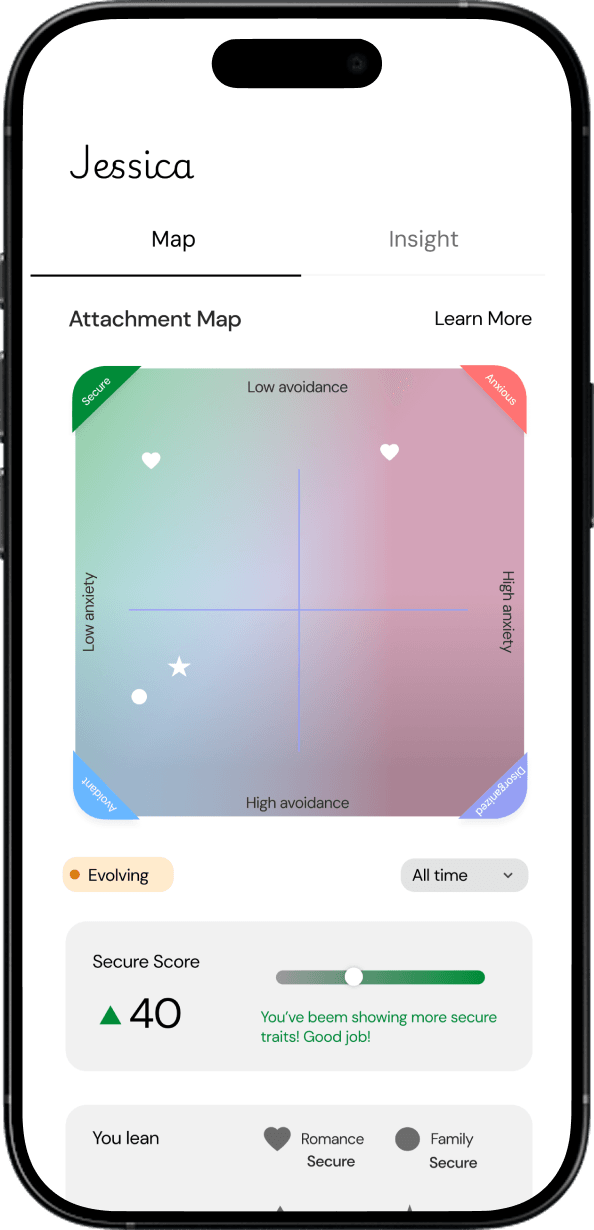
The Attached App Makes Shadow Work Less Intimidating
The part you learned to keep offstage has usually been waiting a long time, and you don't have to coax it out alone on a blank page.
- Shadow journaling for the parts you were taught to hide
- CBT journaling for the anxious thoughts that surface when you get honest
- Forward-looking journaling for learning secure attachment, growth, and new behavior
Because changing doesn't come from writing the same wound forever. Changing starts when the page asks a better question.

Related articles
More reading to help this topic connect across the blog.
One hidden way your employees relate to people at work could secretly be costing your company millions.
What this little monkey can tell you about your relationships, and why IKEA's plush toy being sold out is worrying
Most of the changing happens outside the therapy room. A memoir about Tuesday spirals, therapy homework, and the between-session practice that finally made the pattern real.
How I found an IFS (Internal Family Systems) therapist or coach, step by step — where to look, what to ask about training, how to pick by what you're struggling with, and how to use the waitlist to start parts work.
Understand your attachment style
Read the full guide to each attachment style, or take the quiz to find yours.