Insecure Attachment Is Quietly Costing Your Company Millions

On a Monday.
Your high-potential employee Ann opens a calendar invite from her manager: “Are you available for a call?”
No context.
Ann’s heart jumps.
Ann’s brain races:
“Did I screw something up?”
“Are they mad at me?”
“Am I getting pushed out?”
Ann spends the next two hours rewriting an email, re-checking a deck, replaying every moment from last week’s meeting in her head.
From the outside, you see “Ann is moving slow.”
Inside, Ann’s mind is spiraling: “I’m about to be rejected.”
On a Friday.
Your top engineer Kevin sits in a stand-up.
Someone suggests him changing his approach.
Kevin cross his arms. He gives short answers. He pushes back on everything.
On paper, it’s “resistance to feedback.”
In his body, it’s: “If I let you close, you could control me, hurt me, or see I’m not enough.”
That’s insecure attachment: the way our brains learned to handle closeness and threat, showing up at work.
Kevin and Ann are commonplace in the workplace.
Attachment Styles in the Workplace
Psychologists describe four main adult attachment styles:
- Secure attachment – “I’m okay, other people are mostly safe.”
- Anxious attachment – “I might be abandoned; I need constant proof I’m safe.”
- Avoidant attachment – “Closeness feels risky; I stay self-reliant and distant.”
- Disorganized attachment – “I don’t know if people are safe or dangerous; I swing between clinging or pushing them away.”
Attachment style is your brain’s “relationship template.”
It shapes how safe you feel with family, how close you get in friendships, and how much you trust or fear people in workplace relationships.
If unaddressed, it shapes and impacts every conversation, meeting and interaction.
A 2023 meta-analysis of 151 samples and 36,695 workers pulled these patterns into the workplace and asked:
How do attachment styles relate to job satisfaction, performance, burnout, trust, and leadership?
Securely attached employees tended to show:
- Higher job satisfaction
- Higher organizational commitment
- Higher self-esteem and self-efficacy
- Higher trust in leaders and coworkers
- Better job performance and more “extra-mile” helping behaviors
In another large meta-analysis, secure attachment also predicted better leader–member exchange (LMX) and had incremental predictive power beyond the Big Five personality traits for job satisfaction, job performance, and commitment.
Anxious and avoidant attachment (the insecure styles), showed the opposite pattern:
- Lower job satisfaction and trust
- More burnout and emotional exhaustion
- More surface acting (faking emotions)
- More counterproductive work behaviors
- More depersonalization and inefficacy
Studies of burnout and performance show the same pattern.
- Insecure attachment
- Higher burnout
- Lower performance
How Insecure Attachment Shows Up in Daily Work
Anxious employees
Anxiously attached employees don’t feel securely held by relationships. They fear rejection and abandonment.
At work, they often:
- Interpret “We need to talk” as “You’re in trouble”
- Over-apologize
- Seek constant reassurance
- Ruminate after every meeting
- Take neutral feedback as personal attack
The meta-analyses link anxious attachment to:
- Higher job stress, burnout, and turnover intentions
- Lower self-efficacy and trust
What this means:
- They spend cognitive bandwidth scanning for signs they’re about to be fired or shamed.
- They over-prepare, over-work, and then emotionally crash.
- They stay in roles they hate because they feel trapped rather than loyal.
Avoidant employees
Avoidantly attached employees protect themselves by staying emotionally distant. Closeness feels like a threat
At work, they often:
- Avoid 1:1s or keep them purely transactional
- Say “It’s fine, I’ll do it myself” and resist collaboration
- Stonewall when conflict appears
- Distrust offers of support
Research links avoidant attachment to:
- Lower group cohesion, trust, and job satisfaction
- More burnout and withdrawal behaviors
What this means:
- They hoard work instead of delegating.
- They block real teamwork.
- They quietly disengage and then suddenly resign, or stay physically present but emotionally gone.
Both styles increase the risk of counterproductive work behavior: gossip, compliance issues, absenteeism, subtle sabotage.
That “difficult” employee might don’t actually mean to be “difficult”. They’re just insecurely attached.
Why This Costs Companies Millions
Let’s connect the dots in plain business terms.
Across large samples:
- Insecure attachment is linked to higher burnout and emotional exhaustion.
- Burnout predicts errors, lower productivity, more sick leave, and higher turnover.
- Secure attachment predicts higher performance, more helping behavior, and stronger commitment.
One meta-analytic path model found that attachment style affected job performance, satisfaction, commitment, and turnover intentions through trust in the supervisor. When anxious or avoidant employees struggle to trust their leaders, everything downstream suffers: performance, retention, engagement
- Every unaddressed insecure attachment pattern is a hidden risk on your P&L
- Every move toward secure attachment is a compounding asset for your business
You pay for insecure attachment in:
- Time lost to rumination and conflict
- Missed innovation because people fear speaking up
- Quiet quitting
- Turnover and rehiring costs
- Compliance issues and HR investigations
You don’t see “attachment style” on the budget.
You see “training,” “recruitment,” “legal,” and “lost productivity.”
Attachment Is a Workplace Metric
What attachment theory says:
We are wired to seek a secure base. A person or place we can return to when we feel threatened.
In childhood, it’s a caregiver.
In adulthood, it becomes our partners, close friends… and often, our workplace.
New studies on “workplace attachment” show that people can become securely or insecurely attached to their organization itself. Secure workplace attachment predicts higher well-being and engagement, while anxious and avoidant workplace attachment predict lower well-being and more strain.
This Is a System Design Problem
Leaders may think:
“Attachment is personal. Therapy problem. Not an HR problem.”
The research says otherwise.
Meta-analytic models show that trust in supervisor mediates the effect of attachment style on job performance, satisfaction, commitment, and turnover.
That means:
- You can’t change someone’s childhood.
- You can design leadership and culture so that even anxious and avoidant employees gradually feel safer.
Attachment style is not fully fixed.
Under consistent, reliable, emotionally safe conditions, people can move toward earned secure attachment: a more stable, trusting pattern in relationships.
Workplaces are perfectly positioned to either:
- Reinforce insecurity (through unpredictable, critical, distant leadership). This is costly.
- Or nudge people toward security (through consistency, fairness, and relational support) This is profitable.
What Companies Can Do to Help Employees Shift Toward Secure Attachment
A. Design leadership as a “secure base”
Secure base leaders feel predictable, fair, and available.
Based on attachment and leadership research, that looks like:
- Consistent check-ins
- Short, regular 1:1s with clear structure.
- Agenda includes tasks and relational signals: “What’s one thing that feels heavy this week?”
- Clear expectations and follow-through
- Anxious systems calm down when signals match actions.
- Avoidant systems relax when they know where autonomy begins and ends.
- Feedback that anchors safety first
- Start with belonging: “You’re a valued part of this team.”
- Then move to specifics: “Here’s what needs to change.”
- End with a path: “Here’s how we’ll support you.”
Meta-analytic findings suggest that secure attachment is strongly associated with better leader–member relationships. Leaders who act like secure bases buffer some of the risk carried by insecure employees.
B. Build attachment-aware culture
You can move toward secure culture by:
- Normalizing emotional reality
- Train managers to say things like:
- “It’s normal to feel anxious before big feedback.”
- “It makes sense you want more clarity.”
- This de-shames attachment reactions instead of pathologizing them.
- Train managers to say things like:
- Rewarding healthy interdependence
- Recognize collaboration, mentoring, and asking for help, not just individual heroics.
- Anxious employees learn they don’t need to perform to be seen.
- Avoidant employees learn that relying on others doesn’t equal loss of control.
- Protecting psychological safety
- Clear anti-bullying and anti-gaslighting norms.
- Fast, transparent responses to breaches.
- Insecure systems watch how you respond to harm. That’s where trust builds or dies.
C. Integrate attachment-based tools into your wellness stack
Most corporate wellness programs offer:
- Meditation apps
- Stress management webinars
- Maybe some CBT-based resilience training
To actually touch attachment, add tools that:
- Help employees name their attachment strategy (secure, anxious, avoidant, disorganized). For example, are they feeling anxious with this specific project? Or avoidant towards another colleague?
- Explain how attachment shows up in feedback, conflict, email tone, and leadership
- Teach self-regulation skills for shame spikes, rejection fears, and withdrawal
- Offer micro-lessons on secure communication (“I feel… I need…”)
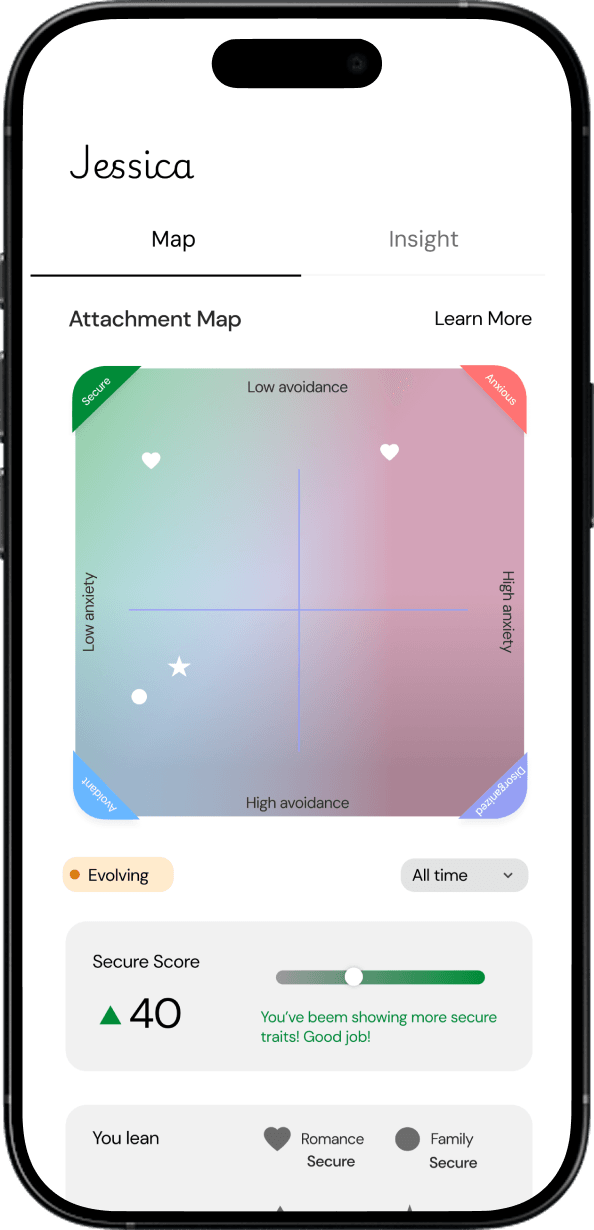
A wellness resource like the Attached app is built for the above.
D. Train managers in attachment-informed leadership
Managers don’t need to become therapists, or they don’t need to recognize attachment patterns either.
Basic attachment-informed training can teach leaders:
- How anxious attachment might show up on their team (over-checking, people-pleasing, drama triangles)
- How avoidant attachment might show up (stonewalling, over-independence, emotional flatness)
- How to respond without reinforcing the pattern
For example:
- With an anxious direct report: anchor safety, give clear boundaries, keep promises.
- With an avoidant direct report: respect autonomy, invite, not force, sharing, offer choices.
Research already shows that attachment styles predict the quality of leader–member exchanges and that trust in supervisor mediates key outcomes. Equipping leaders here is essentially risk management and performance engineering.
If You’re an Reading This and Feeling Seen
Maybe you read “anxious attachment” and felt your stomach flip.
Or you saw “avoidant” and thought, “Oh. That’s why I hate check-ins.”
That means your nervous system adapted to keep you safe in past relationships.
It just doesn’t know that your boss’s calendar invite is not your caregiver’s anger.
Secure attachment will help you feel safer and perform better at a workplace. You can practice it.
That might look like:
- Writing the message and sending it once, instead of editing it 11 times.
- Saying, “I feel defensive right now, can we slow down?” in a 1:1.
- Letting one colleague a little closer and noticing you’re still okay.
- Using a relationship and attachment app to walk you through self-soothing when Slack pings trigger panic.
Over time, your default setting shifts.
And when it does, your work life changes too:
- Feedback stops feeling like exile.
- Collaboration stops feeling like a trap.
- Leadership stops feeling like a test you are always failing.
Sources
-
Warnock, K. N., Ju, C. S., & Katz, I. M. (2024). A Meta-analysis of Attachment at Work. Journal of Business and Psychology.
– Meta-analysis (K = 109, N ≈ 32,278) showing links between attachment styles and job performance, burnout, satisfaction, commitment, and leader-member exchange, plus incremental validity over Big Five traits.
-
Pham, M. (2023). A Meta-Analysis Study of Attachment Styles in the Workplace. Academy of Management Proceedings.
– Meta-analysis of 151 independent samples (N ≈ 36,695 workers) linking secure, anxious, and avoidant attachment to job satisfaction, trust, commitment, performance, group cohesion, burnout, and counterproductive work behavior.
-
Vîrgă, D., Schaufeli, W. B., Taris, T. W., van Beek, I., & Sulea, C. (2019). Attachment styles and employee performance: The mediating role of burnout. The Journal of Psychology.
– Shows how insecure attachment (anxiety, avoidance) relates to higher burnout, which in turn predicts poorer job performance.
-
Ronen, S., & colleagues (2017). Promoting the work engagement of the health worker: The role of secure workplace attachment, perceived spatial-physical comfort, and relationships with patients. Acta Psychologica.
– Demonstrates that secure workplace attachment and a sense of comfort and connection predict higher engagement.
-
Koša, V., & Lisá, E. (2025). The role of meaningful work and workplace attachment styles in entrepreneurial well-being. Frontiers in Psychology.
– Finds that secure workplace attachment and meaningful work support well-being, while anxious and avoidant attachment are linked to lower well-being.
-
Bruny, J. F., et al. (2023). Workplace Attachment Style as Moderator of the Relationship Between Political Skills and Organizational Outcomes. Europe’s Journal of Psychology.
– Explores how workplace attachment style moderates links between political skill, citizenship behaviors, and counterproductive behaviors.
-
Warnock, K. N. (2025). Attachment at Work: A Meta-Analysis. PsyArXiv / related preprints.
– Further elaborates on how attachment styles impact job performance, satisfaction, commitment, turnover intentions, and trust in supervisors via meta-analytic structural models
Related reading

Related articles
More reading to help this topic connect across the blog.
What this little monkey can tell you about your relationships, and why IKEA's plush toy being sold out is worrying
Most people put off shadow work journaling because of wrong ideas about what it is. Here are 5 things people get backwards, and an easier way to start.
Ariana Grande's love songs hit like a journal entry you didn't mean to read out loud. But behind the melodies is a deeper emotional pattern. One that speaks to fear, craving, and growth. Her attachment style might just be yours, too.
Which is the better app for insecure attachment? Anxious, avoidant, disorganized, fearful-avoidant.
Understand your attachment style
Read the full guide to each attachment style, or take the quiz to find yours.