I Tried Every Type of Journaling. Here’s What Actually Works — Complete Guide for Healing, Growth and Relationships

Everyone says “you gotta journal!”
But no one said that journaling could make things worse. Especially if you get stuck in rumination (having the same negative thoughts circling in your head)with the wrong type of journaling.
Journaling helps when you use the right kind for the right emotional job. Research on expressive writing suggests it can support emotional processing, but only when you make meaning from what happened instead of replaying distress on a loop.
In this guide, I’ll run through all different types of journaling that I’ve tried, and which type works for the phase in life you’re in.
1. Brain Dump Journaling

What it is: Empty your brain, literally. No grammar, no structure, no moral lesson. You write the mess, unpolished, unfiltered, just poured out.
How it helps: Creates space between you and the thought. Turns whatever’s going on inside your brain into words you can actually see.
Pros: Clears mental clutter fast. Helps anxious attachers pause before sending five texts; avoidants pause before ghosting.
Cons: Can feed the rumination loop. You might write the same fear ten different ways and feel more anxious, or more convinced that your fear is true.
When to use it: When your mind feels busy. Before a hard conversation.
How to do it:
- Set a timer for 10 minutes. 2. Open a blank page and write without stopping. 3. No editing, no rereading until the timer goes off.
Prompts after dumping:
- What am I carrying right now?
- What line on this page is a fear, not a fact?
2. Daily Journaling
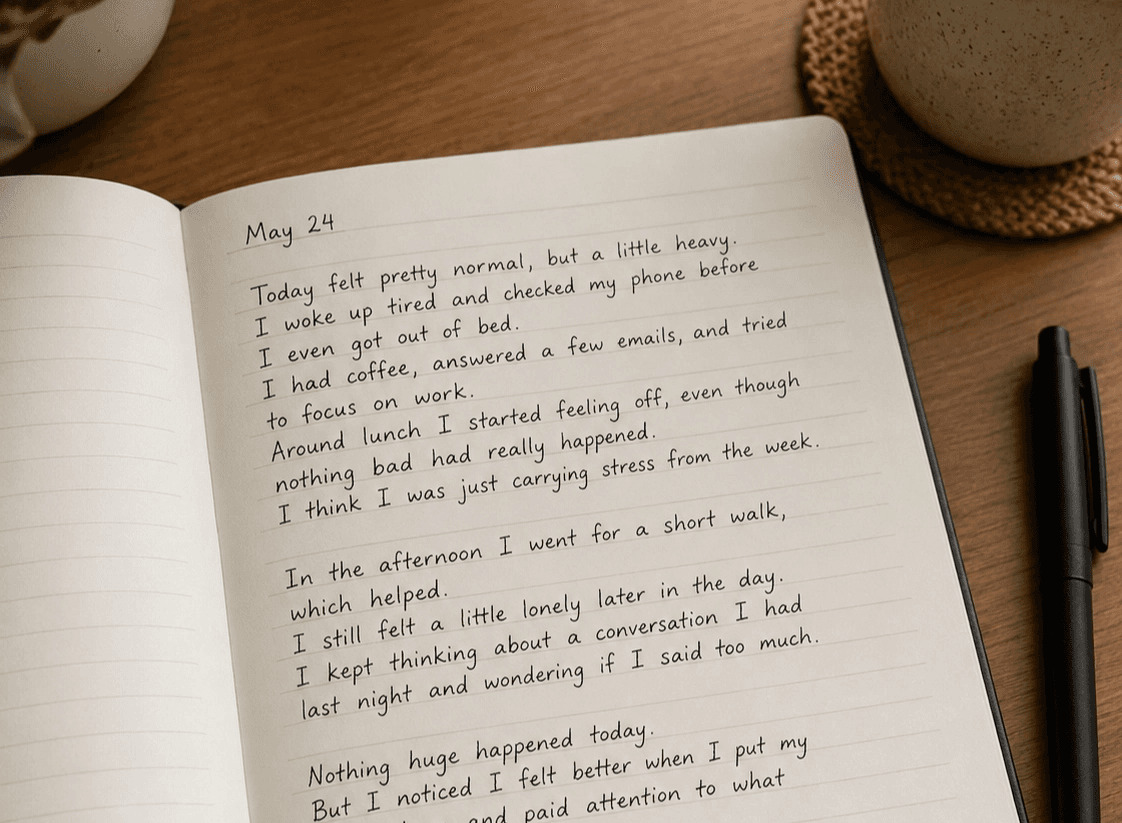
What it is: The one everyone refers to. The “who”, “what”, “where”, “when”, “why” and “I felt”
How it helps: Helps you remember your everyday. Patterns emerge, what triggers you, what you avoid, how you repeat yourself across weeks and months.
Pros: Memory vault. You might notice you feel worse after checking an ex's profile, or that you pick fights when you feel ignored.
Cons: Can become a pain archive. You document everything but change nothing. You become the historian of your hurt.
When to use it: When you want self-awareness. When you want to track relationship patterns over time.
How to do it: Write once a day and note what happened, your thoughts and feelings. Over time, flip back and look for repeated words, names, or feelings (if you’d like to grow).
Prompts:
- What happened today? What did I feel? What pattern did I notice?
- What would best version of me do next?
3. Gratitude Journaling

What it is: Express what you appreciate
How it helps: Research by Emmons and McCullough found people who listed things they were grateful for reported better well-being than those who focused on hassles. So it’ll literally make you feel better
Pros: Trains your brain to see the good, it’ll literally rewire your brain! For anxious attachers, it softens the urge to scan for rejection. For avoidants, it helps them notice that closeness also brings warmth and support.
Cons: Can become avoidance. Writing "I'm grateful for my partner" while your actually think: I feel lonely with them can be a fear of confrontation
When to use it: When your mind keeps focusing on the negatives. If you have a tendency to complain
How to do it: Write three specific things you're grateful for, concrete things from your day like: "I'm grateful my partner made coffee without being asked this morning".
4. Shadow Journaling

What it is: Shadow journaling comes from Jung’s idea of the “shadow”: the hidden parts of the self we reject, suppress, or refuse to see. Shadow journaling reveals it.
How it helps: Tells the truth that helps you feel more relieved. Connects to parts-based therapy, IFS, and schema work.
Anxious attachers can say: I want control because uncertainty scares me.
Avoidants can say: “When someone asks for more closeness, I tell myself they are too needy because I feel trapped and do not know how to say I need space.”
Pros: Deep honesty. Frees up energy that was going toward suppression.
Cons: Can turn harsh or lead to burn out. You might use it to attack yourself instead of understand yourself. Don't dig into your shadow without support.
When to use it: When someone triggers you hard. When you're judging yourself or others. When you want to start doing deep healing.
How to do it: Start with what triggered you. Note the thought that feels scary to say out loud, the petty reaction, the jealousy. Then ask the three prompts below. The goal isn't to shame the part. It's to understand what it learned. If you want help getting past generic questions, the free shadow work journal prompt generator builds a personalized seven-day practice from the trigger you describe.
Prompts:
- What trait in someone else triggers me?
- Where does that trait live in me?
- What is this part trying to protect? What does it need?
5. CBT Journaling
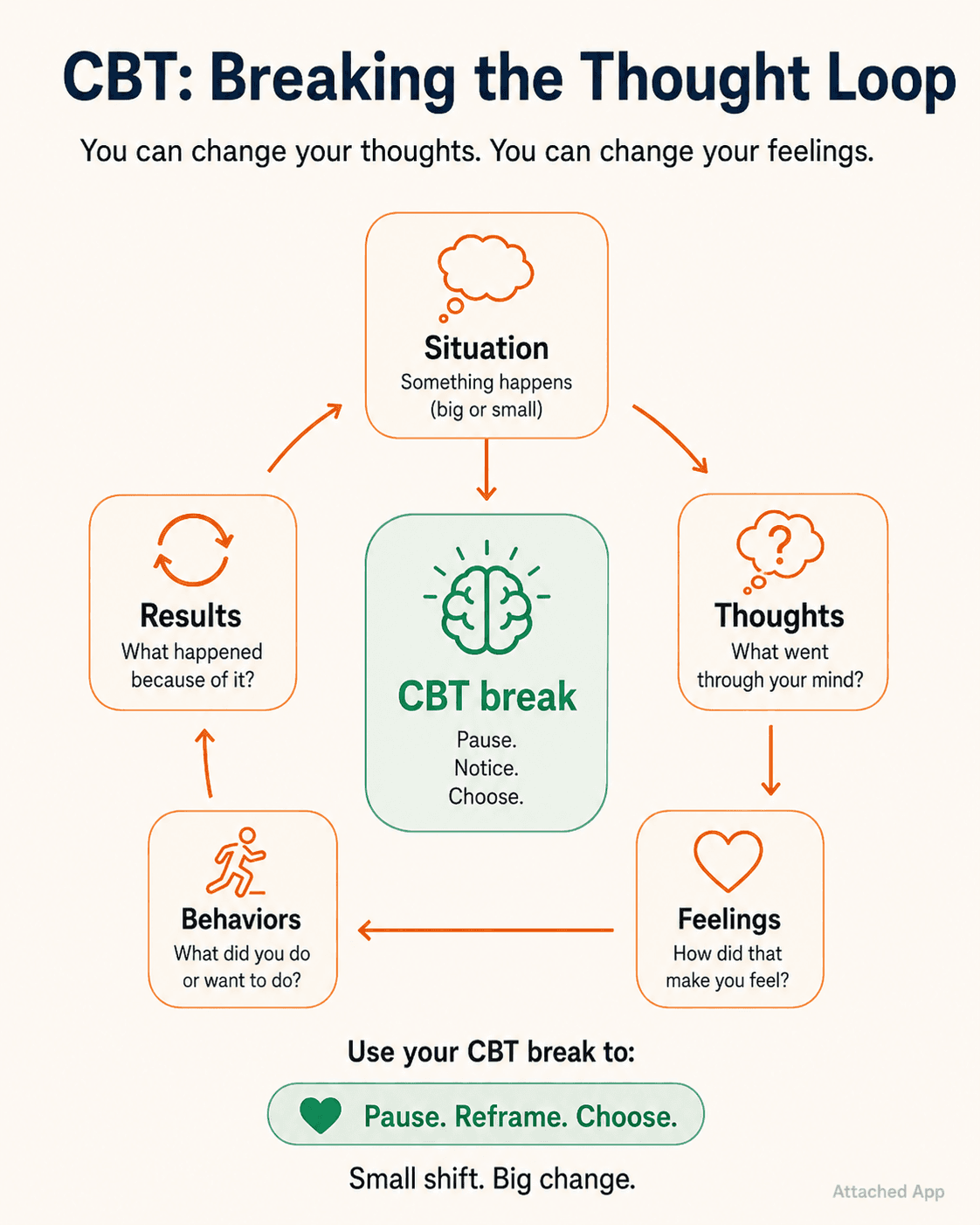
What it is: Many of our thoughts are not true or real. Based on Cognitive Behavioral Therapy, this helps us map the chain: situation → automatic thought → feeling → behavior
How it helps: When you feel you’re spiraling. CBT journaling slows the chain and help you see which of your thoughts are real VS just a story.
Pros: Brings structure. Helps you pause before doing something you might regret in response to a thought that’s not real.
Cons: Can feel too intellectual when you're deep in feelings. Do a brain dump first, then use CBT. Release first, test second.
When to use it: When you catastrophize or overthinking.
How to do it: Work through the six prompts in order. The structure is the point. If you use the Attached app, there's a built-in CBT journaling flow that walks you through each step.
Prompts:
- What happened? 2. What did I tell myself? 3. What emotion did I feel? 4. What evidence supports this thought? What doesn't? 5. What's a more balanced thought? 6. What action protects both my relationship and my self-respect?
6. IFS Parts Journaling
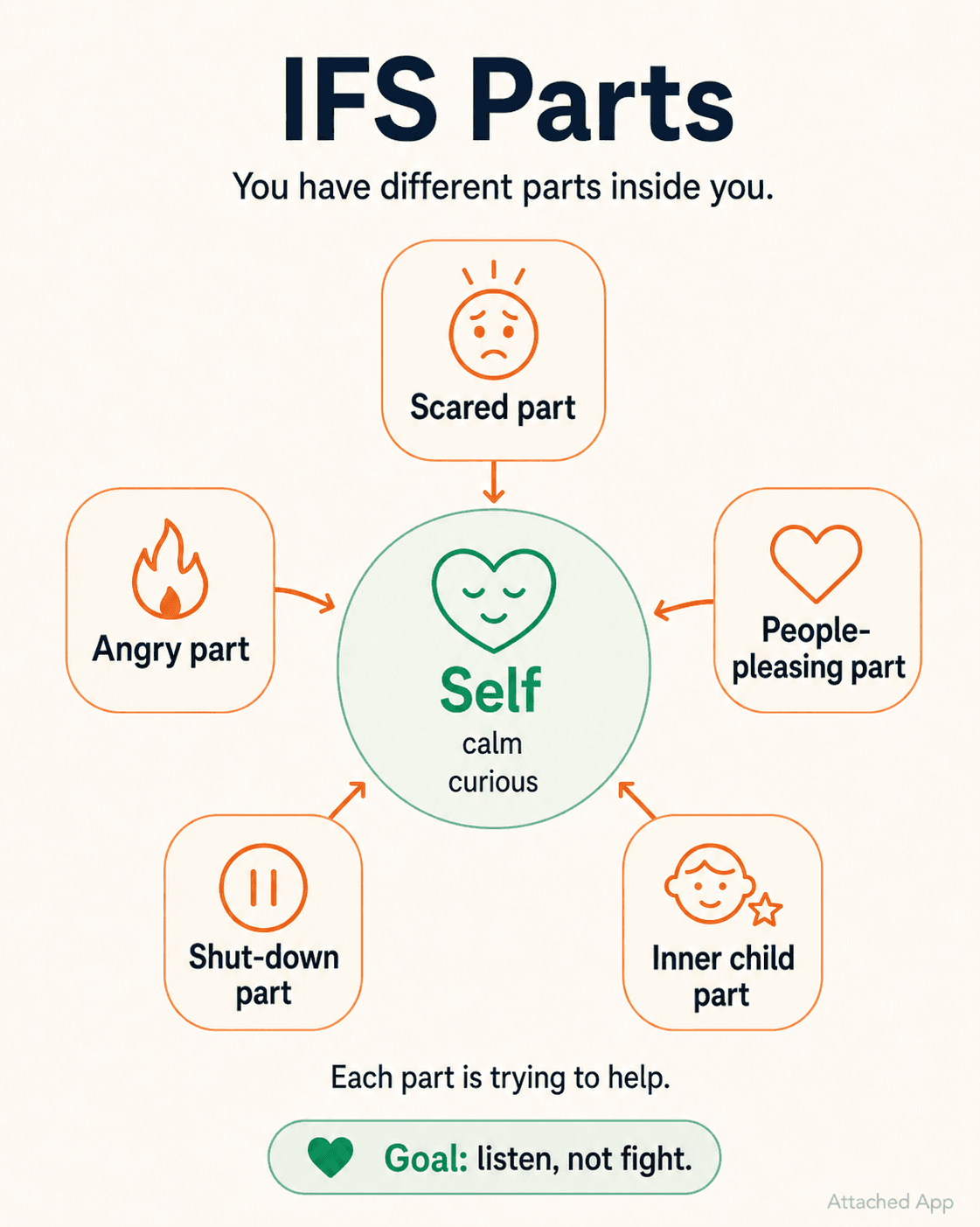
What it is: Based on Internal Family Systems (developed by Richard Schwartz), the idea that you're not one flat voice. You have parts. A part wants love. A part fears rejection. A part wants to test people. A part wants to act cool.
How it helps: Reduces inner war. Instead of I'm crazy, you say a part of me feels terrified. So you can comfort and heal the part.
Pros: Compassionate, non-shaming. Helps you listen to protective parts instead of fighting them.
Cons: Journaling is a limited container for IFS. IFS meditation lets you completely feel and talk to the part, rather than just write about it. Attached app has a feature that allows you to work through your parts with custom guided meditation.
When to use it: When you feel triggered or discomfort. Can be used for any kind of negative feeling.
How to do it: Start with the sentence "A part of me feels…". Then ask it questions like you'd ask a scared child: with curiosity and love. You're not trying to silence the part. You're trying to understand what it learned, give it what it wants and help it.
Prompts:
- A part of me feels… This part wants me to… This part fears… This part learned… What does this part need from me today?
7. Dream Journaling

What it is: Writing down your dreams immediately on waking. Used in Jungian therapy to surface unconscious material that doesn't show up in waking thought.
How it helps: Dreams show symbols, feelings, and characters. The person chasing you might be your own rage. The house you keep returning to might be an old version of yourself. Writing them down builds a relationship with the part of your mind that only talks when you're asleep.
Pros: Surfaces patterns you can't access through logic. People in attachment healing often notice they dream about the same person, the same abandonment scenario, the same locked door, long after they think they've "moved on." The dream knows before you do.
Cons: Most dreams are gone within 5 minutes of waking up. Not every dream means something. Some times, your brain could just be processing a stressful meeting or a weird murder case you read about. Over-interpreting everything can send you down rabbit holes that aren't there.
When to use it: When you feel like something is unresolved but you don’t know what it is exactly. When the same dream keeps returning. When you want to go deeper than what conscious reflection surfaces.
How to do it: Keep a notebook and pen on your nightstand. The moment you wake, write before you do anything else. Don't edit or question it. Capture the feeling first, then the images, then the story. Later, ask what each symbol might mean to you specifically, not what a dream dictionary says.
Prompts:
- What happened in the dream? What did it feel like?
- Who or what appeared — and what do they represent in my waking life?
- What feeling stayed with me after I woke up?
- Have I dreamed this before?
8. Forward-Looking Journaling
What it is: Rise to meet your limiting beliefs. Writing from the future you want to build.
How it helps: Helps you rehearse new choices. Stops you living only from memory. Builds agency.
Pros: Turns insight into practice. Helps you move forward instead of looping in the same cycle.
Cons: Can become fantasy if you don't pair it with actual behavior. The future self needs an action
When to use it: When you feel stuck in old identity. After CBT or shadow work, when you know the pattern and need a new direction.
How to do it: Write in first person, present tense, as your future self, not "I want to be someone who…" but "I am someone who…" Then end every entry with one concrete behavior for the next 24 hours. The vision without the action is just daydreaming. Tools like the Attached app include forward-looking journal guide.
Prompts:
- What pattern am I ready to change?
- What is one action I can take in the next 24 hours?
9. Relationship Journaling
What it is: Writing about how you show up with others through the lens of Emotionally Focused Therapy, developed by Sue Johnson. EFT sees relationship conflict not as two people fighting about content, but as two people sending attachment signals that keep getting missed. The journaling version helps you find the signal underneath your reaction.
How it helps: Most couples argue about the surface, the dishes, the late reply, the tone of voice. EFT journaling goes one layer down: what did I need, and what did I do when I didn't get it? Anxious attachers protest loudly. Avoidants go quiet. Writing it down before you speak it out loud changes what comes out of your mouth.
Pros: Go from blame to vulnerability. Helps you find the vulnerable emotion underneath the anger. I.e. hurt or fear.
Cons: Hard to do honestly mid-conflict. If you're still flooded, the page will just collect accusations. Wait until your nervous system has settled before you write.
When to use it: After conflict. Before a hard conversation. When you keep having the same fight with different words.
How to do it: Work through the prompts in order. The most important step is distinguishing your secondary emotion (anger, irritation, shutdown) from your primary one (fear, sadness, loneliness, shame). That's where EFT lives. Tools like the Attached app include relationship journaling prompts built around attachment repair if you want guided structure.
Prompts:
- What happened — and what did I feel on the surface?
- What was the softer feeling underneath that?
- What did I need that I didn't ask for clearly?
- What attachment fear got triggered — abandonment, rejection, being trapped, being too much?
- What repair would help? What can I own?
10. The Artist's Way — Morning Pages
What it is: Three pages of longhand stream-of-consciousness writing, done first thing every morning. Developed by Julia Cameron in The Artist's Way. Not meant for insights, just stream of consciousness.
How it helps: De-clutter your mind before the day begins. Cameron describes them as "the primary tool of creative recovery", a way to drain the anxious, critical, cluttered mind so something clearer can come through.
Pros: Over weeks, things surface on the page that you didn't know you were carrying. Especially useful for creatives, overthinkers, and anyone who can't switch off.
Cons: Takes roughly 20–30 minutes daily. Some people find that without a reflective prompt, they circle the same thoughts without resolution. Morning pages clear the room but don't always fix things.
When to use it: When you feel creatively or emotionally blocked.
How to do it: Before you check your phone, before you talk to anyone, write three pages by hand. Write whatever comes: complaints, nonsense, half-formed thoughts, grocery lists. Cameron is explicit: don't reread them, at least for the first few weeks.
Prompts: None. Just write until three pages are full.
11. Bullet Journaling
What it is: A structured analog system created by Ryder Carroll that combines a planner, diary, and to-do list in one notebook. You use rapid logging — short bullets with symbols (tasks, events, notes) — to track what happened, what needs doing, and what matters.
How it helps: Bullet journaling is less about emotional processing and more about getting your thoughts, tasks, and intentions organized so you can see them clearly. The creator of Bullet Journaling found it helped him with his ADHD tremendously.
Pros: Super flexible, you design it around your life. Helps you notice what you keep putting off, what drains you, what you keep saying yes to. The monthly and weekly review process builds self-awareness over time.
Cons: Can become more about the aesthetics than the practice, especially on Pinterest or Instagram, where it looks like an art project. Also: this is organizational, not therapeutic. Pair it with one of the emotionally-focused journals above if you want inner work too.
When to use it: When you feel scattered, overwhelmed, or like your life is happening to you. If you like to be creative.
How to do it: Check out bullet journal guides on Youtube
Prompts (for reflection spreads):
- What did I avoid this week? Why?
- What am I saying yes to that I want to say no to?
- What did I actually spend my time on vs. what I said mattered?
Which Journal For When
| Feeling | Use |
|---|---|
| "My brain will not shut up." | Brain dump |
| "I want to understand my patterns." | Daily journaling |
| "I feel like everything sucks" | Gratitude |
| "I hate this feeling, but I know it means something." | Shadow |
| "I believe every scary thought." | CBT |
| "I get triggered easily" | IFS parts |
| "I know the pattern. Now I need to change." | Forward-looking |
| "We keep having the same fight." | Relationship (EFT) |
| "I feel blocked and creatively stuck" | Morning pages |
| "My tasks, thoughts, and life feel scattered." | Bullet journal |
| "My dreams keep showing me something weird." | Dream |
When to Use An App VS Blank Page Notebook Journaling
I moved from notebook journaling to app journaling when I got sick and tired of carrying my heavy notebook, and the below:
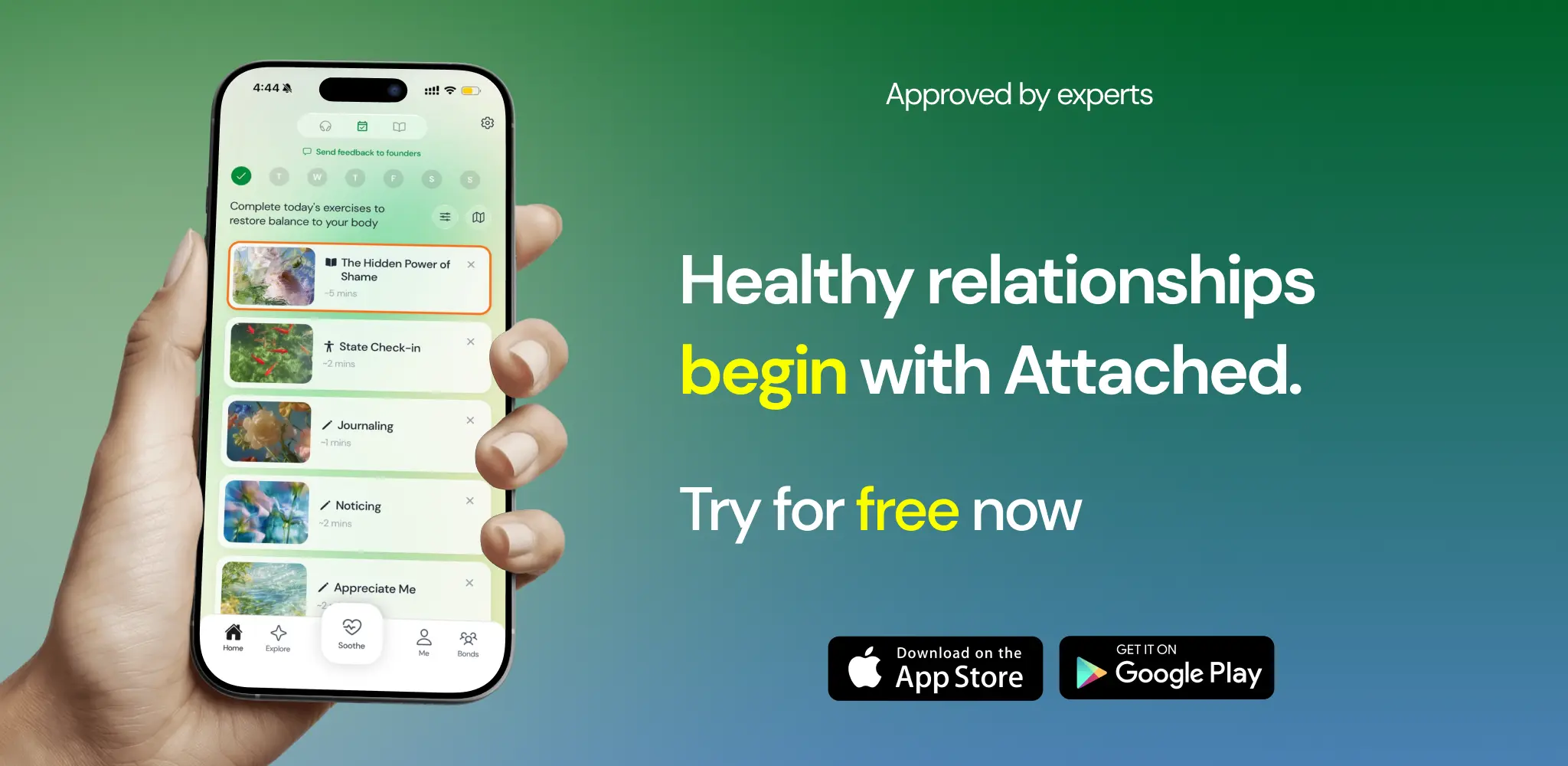
A guided app like Attached
- Works best when you're triggered and can't remember what to ask yourself
- Prompts built around your memory — personalized and dedicated to your growth
- Journal can automatically spot patterns, summarize and give you exercises for growth
Notebook journaling
- Works best when you already have a framework in your head
- Works best for brain dump, Morning Pages (Artist Way) and dream journaling.
- Gives you total freedom, which can go either way
The Attached App Makes This Easier
You do not need to figure this out alone on a blank page.
The Attached app includes:
- Shadow journaling for the truth
- CBT journaling for anxious thoughts, distorted stories, and relationship triggers.
- Forward-looking journaling for secure attachment, growth, and new behavior.
Because healing does not come from writing the same wound forever.
Healing starts when the page asks a better question.
Related articles
More reading to help this topic connect across the blog.
I spent thousands of dollars so you don't have to. Here's which type of meditation to use for what, from mindfulness to IFS to Ideal Parent Figure.
Sick and tired of being clingy, overthinking your relationships (aka, anxious attachment), and always being the 'demanding' one? Introducing a new challenge to help you change, finally.
Most people put off shadow work journaling because of wrong ideas about what it is. Here are 5 things people get backwards, and an easier way to start.
What if, you've never been in love before? Here are 7 signs you've never felt real, genuine love.
Understand your attachment style
Read the full guide to each attachment style, or take the quiz to find yours.