Finde heute deinen Bindungsstil heraus. Entdecke deinen Beziehungsplan, allein oder mit Partner
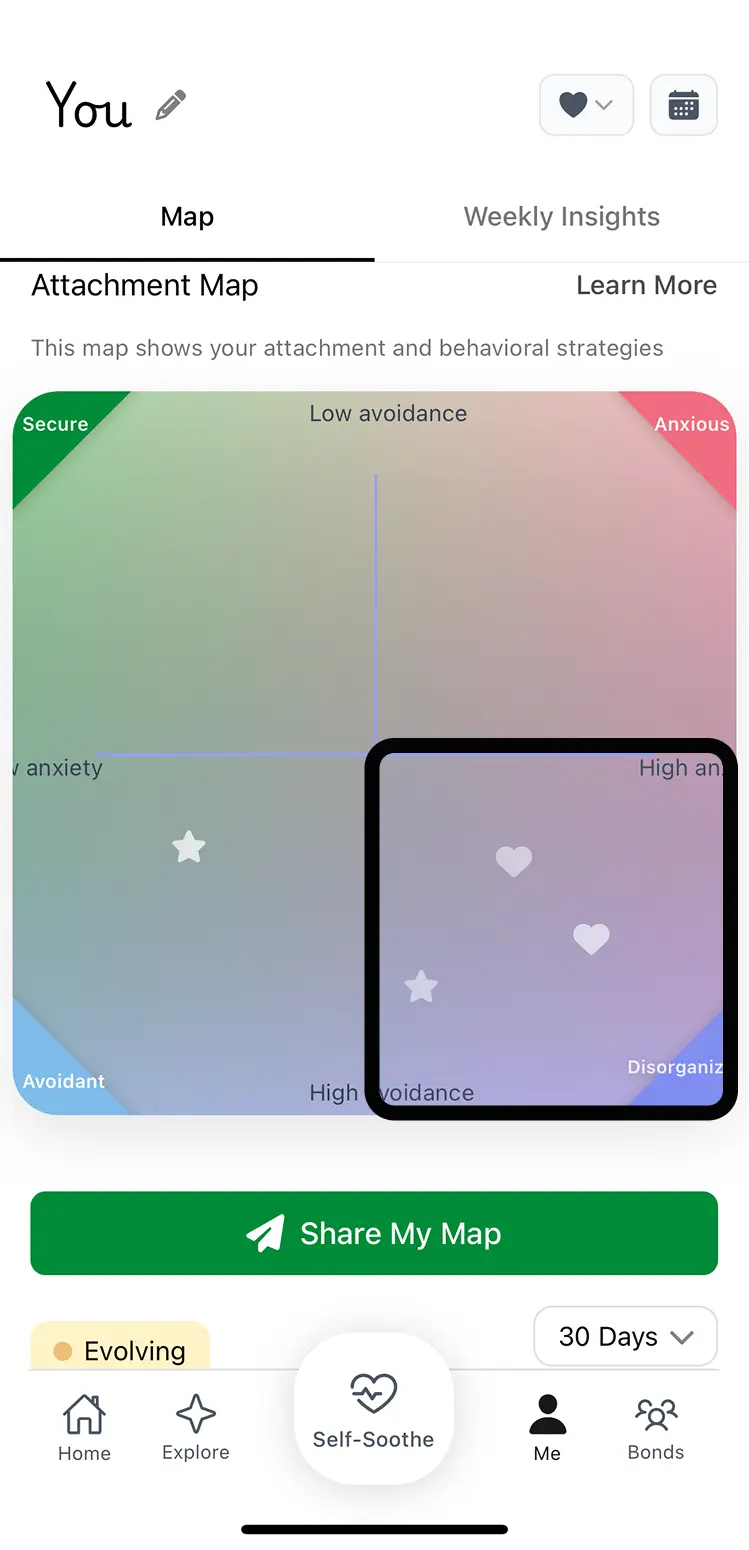
Desorganisierte Bindung: Wenn du Liebe willst und dein Körper trotzdem Alarm schlägt

Wenn Liebe sich gefährlich anfühlt
Du willst Nähe, aber sobald sie da ist, wird es beängstigend.
Du willst Loyalität, aber wenn jemand bleibt, fällt Vertrauen schwer.
Du ziehst dich zurück, um dich zu schützen, und willst kurz darauf wieder Nähe.
So fühlt sich desorganisierte Bindung oft an.
Was ist desorganisierte Bindung?
Desorganisierte Bindung, oft auch fearful-avoidant genannt, vereint zwei gegensätzliche Impulse:
- das ängstliche Verlangen nach Nähe
- die vermeidende Angst vor Verletzung, Kontrolle oder Überwältigung
Genau deshalb fühlt sich dieser Stil oft so verwirrend an. Ein Teil will Verbindung, der andere schaltet auf Überleben.
Typische Anzeichen bei Erwachsenen
Typische Anzeichen sind:
- Du sehnst dich nach tiefer Verbindung und wirst davon gleichzeitig überfordert.
- Du fühlst dich oft zu emotional nicht verfügbaren Menschen hingezogen.
- Du testest andere oder stößt sie weg, um zu sehen, ob sie bleiben.
- Ruhige Liebe fühlt sich ungewohnt an, Intensität dagegen vertraut.
- Beziehungen erleben häufig starke Hochs und Tiefs.
- Du fürchtest sowohl Verlassenwerden als auch zu viel Nähe.
Woher kommt das?
Dieses Muster entsteht oft dann, wenn die Person, die Sicherheit geben sollte, gleichzeitig Quelle von Angst, Chaos oder Verwirrung war.
Das Nervensystem lernt dann:
"Verbindung ist das, was ich brauche, und gleichzeitig etwas, das mich verletzen kann."
So bleibt der Körper zwischen Annäherung und Rückzug hängen.
Auch der Körper reagiert
Desorganisierte Bindung ist kein rein mentales Muster. Sie zeigt sich auch im Körper.
Wenn Liebe mit Angst verknüpft ist, kann das Nervensystem reagieren mit:
- Hypervigilanz
- Erstarren
- Nähe suchen und dann wieder fliehen
- emotionaler Erschöpfung
Deshalb kann sich ein Teil von dir nach Intimität sehnen, während ein anderer gleichzeitig Panik bekommt.
Desorganisiert vs. andere Bindungsstile
| Bindungsstil | Zentrale Angst | Muster in Beziehungen | Regulation |
|---|---|---|---|
| Sicher | Geringe Verlustangst | Offen, stabil, vertrauensvoll | Beruhigt sich und kommuniziert |
| Ängstlich | Verlassenwerden | Sucht Nähe und Bestätigung | Hyperaktivierung |
| Vermeidend | Vereinnahmung | Zieht sich zurück und minimiert | Deaktivierung |
| Desorganisiert | Nähe und Verlust zugleich | Push-Pull, Intensität, Widerspruch | Wechsel zwischen beidem |
Wie mehr Sicherheit beginnen kann
Veränderung beginnt damit, innere und relationale Sicherheit neu aufzubauen.
-
Hilf deinem Körper, Sicherheit zu erkennen.
Grounding, Atmung, somatische Arbeit und Wiederholung sind hier zentral. -
Baue Verlässlichkeit auf.
Wiederholte Stabilität hilft dem Nervensystem, sich neu zu orientieren. -
Benenne deine inneren Zustände.
"Ich will Nähe und gleichzeitig fliehen" ist bereits ein wichtiger Schritt. -
Übe kleine Dosen von Nähe.
Vertrauen muss nicht auf einmal entstehen. Sicherheit wächst schrittweise. -
Such dir bindungs- und traumasensible Unterstützung.
Dieser Stil profitiert oft stark von Arbeit mit Körper, Geschichte und Beziehung zugleich.
Die Attached App unterstützt dich mit Übungen und Tools, um vom Überlebensmodus zu mehr sicherer Verbindung zu kommen.
FAQ
FAQ
Do I have to be in a relationship to use this app? Can I use it alone?
Who's Eden the relationship coach from Attached?
I've tried talk therapy before but it hasn't helped, how is Attached any different?
- Online talk therapy: Many online therapists on general platforms may not specialize in attachment-based issues.
- Attached: Built around attachment patterns, guided reflection, and relationship habits, our tools help you notice the patterns behind relationship stress and practice different responses.
- Online talk therapy: Many platforms match you randomly with a therapist who may not have deep attachment expertise.
- Attached: Backed by experts in attachment; we designed the app around relationship reflection, attachment education, and daily practice.
- Online talk therapy: Providers may not remember every detail between sessions.
- Attached: Eden remembers and adapts to your journey.
- Online talk therapy: Limited hours of availability.
- Attached: 24/7 access so you can manage triggers and exercises anytime.
How is Attached different to ChatGPT?
- ChatGPT: General purpose AI assistant.
- Attached: Built for attachment patterns, self-reflection, and relationship habits.
- ChatGPT: Answers general inquiries.
- Attached: Uses psychology-informed prompts to help you reflect, slow down, and choose your next step.
- Bite-sized lessons based on relationship science
- Eden, your coach, grounded in relationship psychology
- Personalized meditations
- Accountability via gamification
How is attachment related to my interpersonal problems?
Does this still help if I'm currently in therapy?
Do I need to give a credit card to start the trial?
Is my data safe?
Can I use Attached for all attachment styles?
I don't have insecure attachment. Can I use Attached for general wellness?
Discover your attachment style now and get a personalized plan
Attached is changing thousands of lives
Even in therapy, I struggled to be fully honest, mostly out of embarrassment over irrational thoughts. But this app made it safe. The app's slow, intentional pacing helped me absorb the lessons and reflect on how they apply to my life. The Trigger Cards were a game-changer—custom to my real triggers and guide me in the moment. I've started recognizing how my anxious attachment shows up and blocks me from fully experiencing love.
I'm very grateful for this app as it has been helping me understand myself and my patterns, encouraging growth through self-compassionate journaling, reflection, and habit tracking. My favorite part is the personalized meditations created uniquely for me.
After my divorce and the death of my best friend and mother, I struggled to adapt. I've been in therapy for years and this app is an incredible tool to help me practice the things my therapist recommends. The journaling tool reframes thoughts using AI, and the meditation feature guides acceptance, breathing, and grounding techniques.
This app is beyond helpful. It simplifies your journey through lessons, guided meditations, and journal prompts. It keeps you on track and maps your progress. It's worth the investment and I'm so glad I found it!
Even in therapy, I struggled to be fully honest, mostly out of embarrassment over irrational thoughts. But this app made it safe. The app's slow, intentional pacing helped me absorb the lessons and reflect on how they apply to my life. The Trigger Cards were a game-changer—custom to my real triggers and guide me in the moment. I've started recognizing how my anxious attachment shows up and blocks me from fully experiencing love.
I'm very grateful for this app as it has been helping me understand myself and my patterns, encouraging growth through self-compassionate journaling, reflection, and habit tracking. My favorite part is the personalized meditations created uniquely for me.
After my divorce and the death of my best friend and mother, I struggled to adapt. I've been in therapy for years and this app is an incredible tool to help me practice the things my therapist recommends. The journaling tool reframes thoughts using AI, and the meditation feature guides acceptance, breathing, and grounding techniques.
This app is beyond helpful. It simplifies your journey through lessons, guided meditations, and journal prompts. It keeps you on track and maps your progress. It's worth the investment and I'm so glad I found it!
Start with a free week on us, no credit card needed.
After free week
What could cost you $7,600/year is now $156/year
No credit card to start
FAQ
Do I have to be in a relationship to use this app? Can I use it alone?
Who's Eden the relationship coach from Attached?
I've tried talk therapy before but it hasn't helped, how is Attached any different?
- Online talk therapy: Many online therapists on general platforms may not specialize in attachment-based issues.
- Attached: Built around attachment patterns, guided reflection, and relationship habits, our tools help you notice the patterns behind relationship stress and practice different responses.
- Online talk therapy: Many platforms match you randomly with a therapist who may not have deep attachment expertise.
- Attached: Backed by experts in attachment; we designed the app around relationship reflection, attachment education, and daily practice.
- Online talk therapy: Providers may not remember every detail between sessions.
- Attached: Eden remembers and adapts to your journey.
- Online talk therapy: Limited hours of availability.
- Attached: 24/7 access so you can manage triggers and exercises anytime.
How is Attached different to ChatGPT?
- ChatGPT: General purpose AI assistant.
- Attached: Built for attachment patterns, self-reflection, and relationship habits.
- ChatGPT: Answers general inquiries.
- Attached: Uses psychology-informed prompts to help you reflect, slow down, and choose your next step.
- Bite-sized lessons based on relationship science
- Eden, your coach, grounded in relationship psychology
- Personalized meditations
- Accountability via gamification