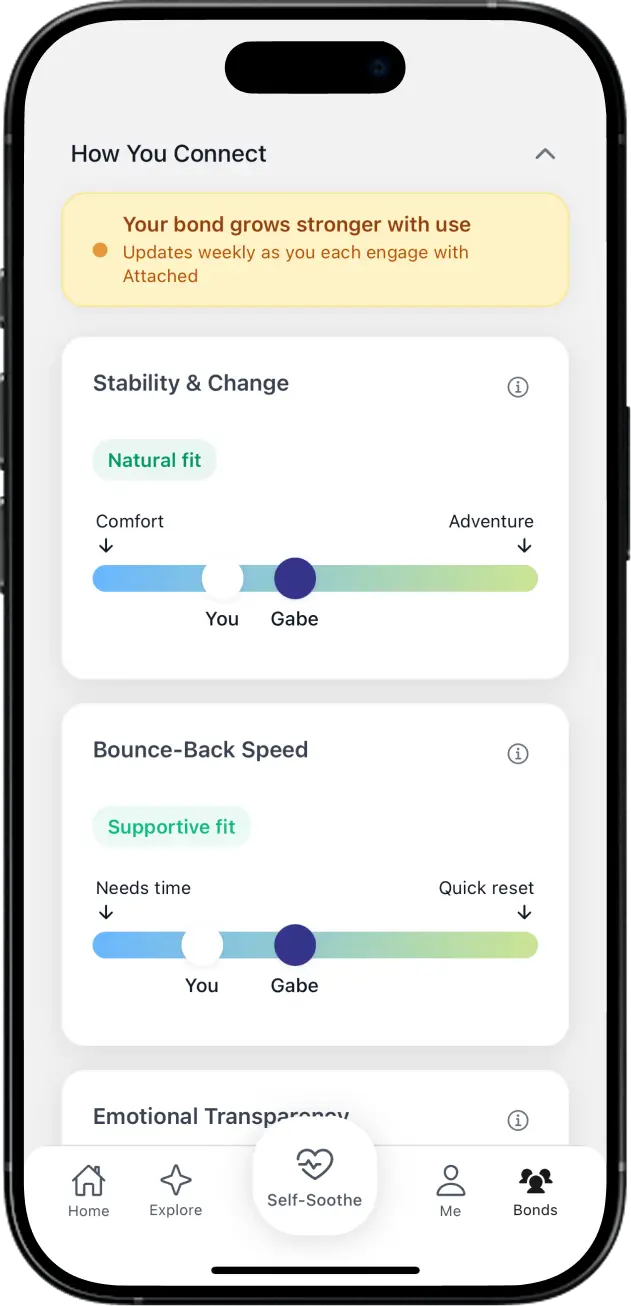
Finde heute deinen Bindungsstil heraus. Entdecke deinen Beziehungsplan, allein oder mit Partner
Vermeidende Bindung: Anzeichen, Ursachen und wie Öffnung möglich wird

Wenn Nähe zu viel wird
Du willst Verbindung, aber sobald jemand dir wirklich nahekommt, entsteht der Drang, Abstand zu schaffen.
Du möchtest Intimität, aber bei echter Verletzlichkeit will dein System lieber dichtmachen.
So zeigt sich vermeidende Bindung oft.
Was ist vermeidende Bindung?
Vermeidende Bindung ist ein unsicherer Bindungsstil, bei dem Selbstgenügsamkeit zur Schutzstrategie wird.
Sie entsteht häufig dann, wenn emotionale Bedürfnisse früher abgewertet, zurückgewiesen oder nicht zuverlässig beantwortet wurden.
Der innere Lernsatz lautet dann:
- Nähe ist nicht sicher.
- Zu viel Fühlen ist riskant.
- Ich verlasse mich besser nur auf mich selbst.
Typische Anzeichen bei Erwachsenen
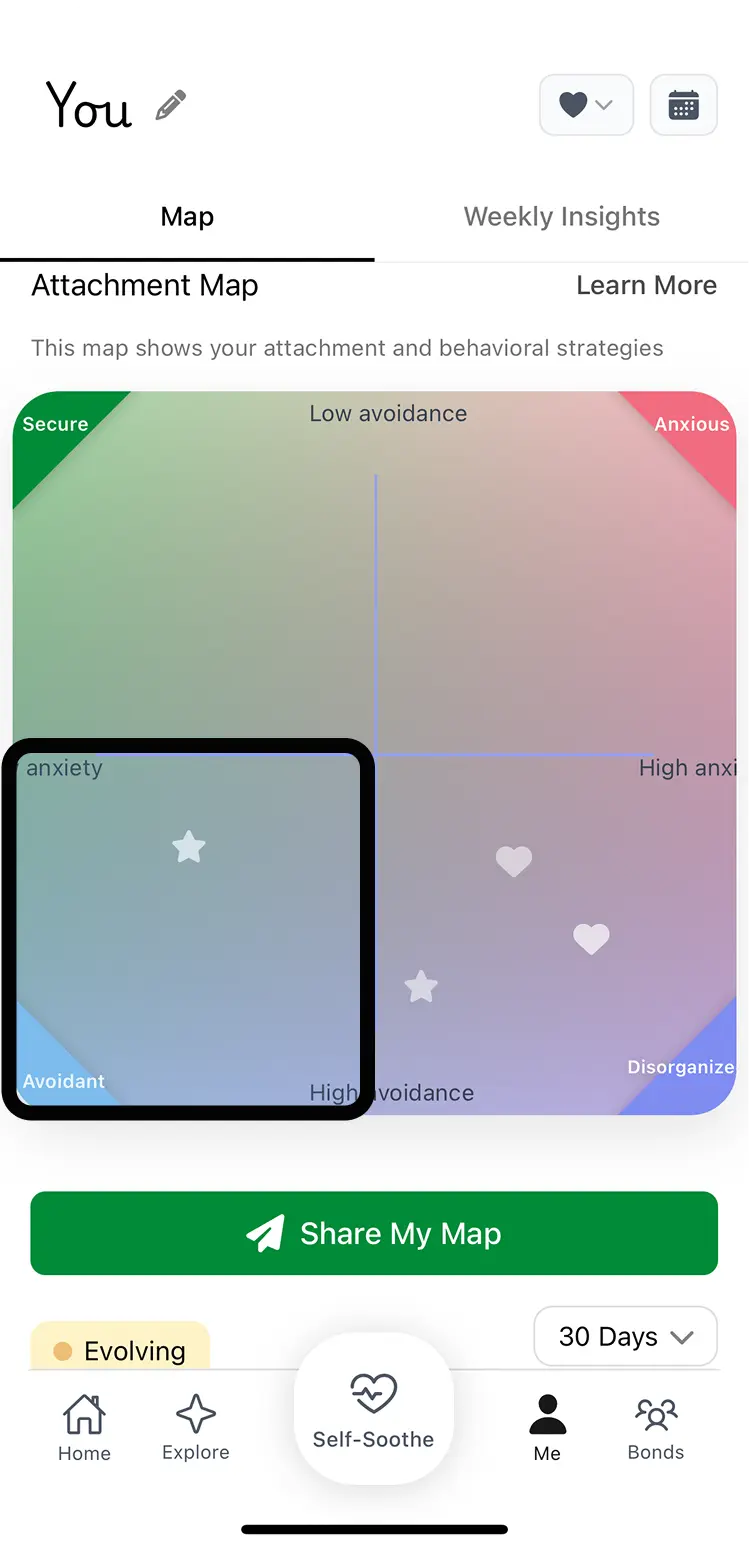
Anzeichen können sein:
- Du brauchst viel Raum, um dich wohlzufühlen.
- Es fällt dir schwer, emotionale Bedürfnisse klar zu benennen.
- Du fühlst dich schnell unter Druck, wenn jemand viel Nähe möchte.
- Bei Konflikt oder Verletzlichkeit ziehst du dich zurück oder wirst sehr sachlich.
- Wenn es ernst wird, suchst du plötzlich Gründe für Distanz.
- Intimität fühlt sich schnell nach Kontrollverlust oder Enge an.
Woher kommt das?
Oft entsteht dieses Muster, wenn Trost oder emotionale Nähe früher nicht zuverlässig verfügbar waren.
Dann lernt das Nervensystem:
"Wenn ich niemanden brauche, kann mich auch niemand verletzen."
Im Erwachsenenalter wirkt das oft wie Stärke. Gleichzeitig kann es aber zu Distanz, Einsamkeit und Schwierigkeiten mit tiefer Verbindung führen.
Auch der Körper reagiert
Vermeidende Bindung ist nicht nur ein Gedanke. Sie zeigt sich auch körperlich.
Wenn Nähe mit Vereinnahmung oder Kontrollverlust verknüpft ist, reagiert das Nervensystem mit Rückzug:
- Spannung im Körper
- emotionales Abschalten
- Flucht in Logik
- starker Wunsch nach Raum
Darum sagt der Kopf manchmal „ich will Nähe“, während der Körper „geh weg“ signalisiert.
Vermeidend vs. andere Bindungsstile
| Bindungsstil | Zentrale Angst | Muster in Beziehungen | Regulation |
|---|---|---|---|
| Sicher | Geringe Verlustangst | Offen, stabil, vertrauensvoll | Beruhigt sich und kommuniziert |
| Ängstlich | Verlassenwerden | Sucht Nähe und Bestätigung | Hyperaktivierung |
| Vermeidend | Vereinnahmung | Zieht sich zurück und minimiert | Deaktivierung |
| Desorganisiert | Nähe und Verlust zugleich | Push-Pull und Intensität | Wechsel zwischen beidem |
Wie es sich in Beziehungen zeigt
In Beziehungen zeigt sich vermeidende Bindung oft als:
- starkes Bedürfnis nach Unabhängigkeit
- Rückzug, wenn das Gegenüber mehr Tiefe will
- Schwierigkeiten, in emotionalen Gesprächen präsent zu bleiben
- Überforderung bei zu viel Intensität
Das heißt nicht, dass du nichts fühlst. Es heißt, dass dein System gelernt hat, sich durch Distanz zu schützen.
Wie mehr Nähe möglich werden kann
Veränderung bedeutet nicht, Unabhängigkeit aufzugeben. Es bedeutet zu lernen, dass Nähe sie nicht zerstören muss.
-
Erkenne den Moment des Abschaltens.
Benenne, was passiert: "ich ziehe mich zurück", "es ist mir gerade zu viel", "ich will fliehen". -
Übe kleine Dosen von Nähe.
Sicherheit entsteht nicht auf einmal, sondern Schritt für Schritt. -
Formuliere ein kleines Bedürfnis.
Schon eine kleine Bitte kann deinem System zeigen, dass Abhängigkeit nicht automatisch Gefahr bedeutet. -
Arbeite mit dem Körper, nicht nur mit Gedanken.
Atmung, Grounding und somatische Regulation helfen, wenn Intimität Alarm auslöst. -
Such dir bindungsorientierte Unterstützung.
Gute Begleitung hilft, Schutzmechanismen weicher zu machen, ohne dich zu überfordern.
Die Attached App unterstützt dich dabei, von Distanz zu sicherer Verbindung zu kommen.
FAQ
FAQ
Do I have to be in a relationship to use this app? Can I use it alone?
Who's Eden the relationship coach from Attached?
I've tried talk therapy before but it hasn't helped, how is Attached any different?
- Online talk therapy: Many online therapists on general platforms may not specialize in attachment-based issues.
- Attached: Built around attachment patterns, guided reflection, and relationship habits, our tools help you notice the patterns behind relationship stress and practice different responses.
- Online talk therapy: Many platforms match you randomly with a therapist who may not have deep attachment expertise.
- Attached: Backed by experts in attachment; we designed the app around relationship reflection, attachment education, and daily practice.
- Online talk therapy: Providers may not remember every detail between sessions.
- Attached: Eden remembers and adapts to your journey.
- Online talk therapy: Limited hours of availability.
- Attached: 24/7 access so you can manage triggers and exercises anytime.
How is Attached different to ChatGPT?
- ChatGPT: General purpose AI assistant.
- Attached: Built for attachment patterns, self-reflection, and relationship habits.
- ChatGPT: Answers general inquiries.
- Attached: Uses psychology-informed prompts to help you reflect, slow down, and choose your next step.
- Bite-sized lessons based on relationship science
- Eden, your coach, grounded in relationship psychology
- Personalized meditations
- Accountability via gamification
How is attachment related to my interpersonal problems?
Does this still help if I'm currently in therapy?
Do I need to give a credit card to start the trial?
Is my data safe?
Can I use Attached for all attachment styles?
I don't have insecure attachment. Can I use Attached for general wellness?
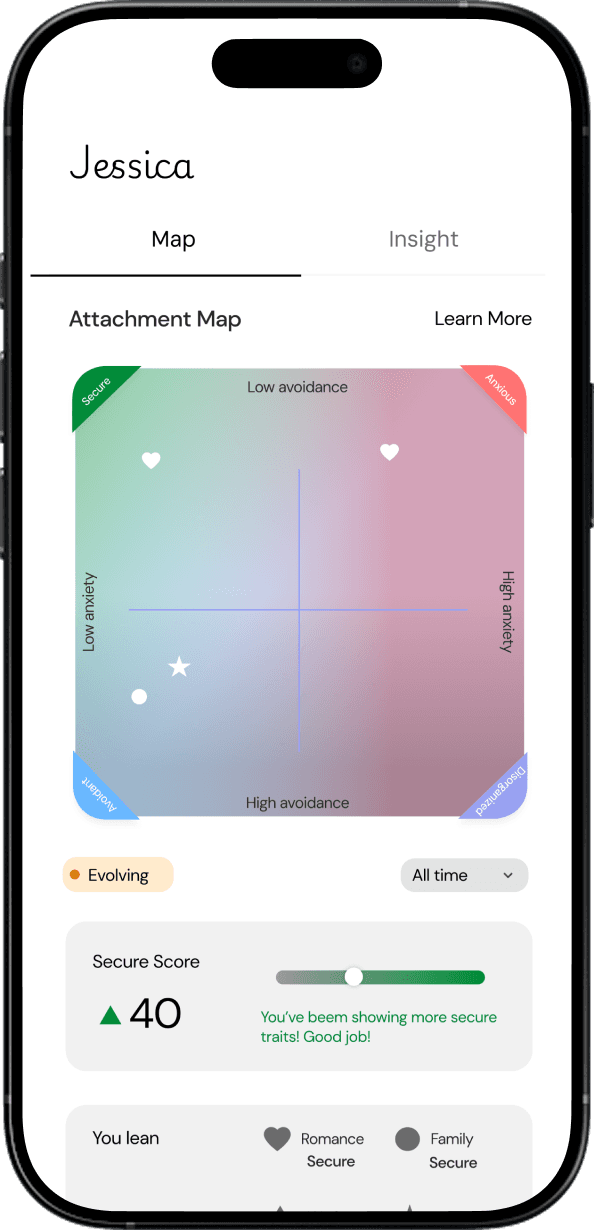
Discover your attachment style now and get a personalized plan
Attached is changing thousands of lives
Even in therapy, I struggled to be fully honest, mostly out of embarrassment over irrational thoughts. But this app made it safe. The app's slow, intentional pacing helped me absorb the lessons and reflect on how they apply to my life. The Trigger Cards were a game-changer—custom to my real triggers and guide me in the moment. I've started recognizing how my anxious attachment shows up and blocks me from fully experiencing love.
I'm very grateful for this app as it has been helping me understand myself and my patterns, encouraging growth through self-compassionate journaling, reflection, and habit tracking. My favorite part is the personalized meditations created uniquely for me.
After my divorce and the death of my best friend and mother, I struggled to adapt. I've been in therapy for years and this app is an incredible tool to help me practice the things my therapist recommends. The journaling tool reframes thoughts using AI, and the meditation feature guides acceptance, breathing, and grounding techniques.
This app is beyond helpful. It simplifies your journey through lessons, guided meditations, and journal prompts. It keeps you on track and maps your progress. It's worth the investment and I'm so glad I found it!
Even in therapy, I struggled to be fully honest, mostly out of embarrassment over irrational thoughts. But this app made it safe. The app's slow, intentional pacing helped me absorb the lessons and reflect on how they apply to my life. The Trigger Cards were a game-changer—custom to my real triggers and guide me in the moment. I've started recognizing how my anxious attachment shows up and blocks me from fully experiencing love.
I'm very grateful for this app as it has been helping me understand myself and my patterns, encouraging growth through self-compassionate journaling, reflection, and habit tracking. My favorite part is the personalized meditations created uniquely for me.
After my divorce and the death of my best friend and mother, I struggled to adapt. I've been in therapy for years and this app is an incredible tool to help me practice the things my therapist recommends. The journaling tool reframes thoughts using AI, and the meditation feature guides acceptance, breathing, and grounding techniques.
This app is beyond helpful. It simplifies your journey through lessons, guided meditations, and journal prompts. It keeps you on track and maps your progress. It's worth the investment and I'm so glad I found it!
Start with a free week on us, no credit card needed.
After free week
What could cost you $7,600/year is now $156/year
No credit card to start
FAQ
Do I have to be in a relationship to use this app? Can I use it alone?
Who's Eden the relationship coach from Attached?
I've tried talk therapy before but it hasn't helped, how is Attached any different?
- Online talk therapy: Many online therapists on general platforms may not specialize in attachment-based issues.
- Attached: Built around attachment patterns, guided reflection, and relationship habits, our tools help you notice the patterns behind relationship stress and practice different responses.
- Online talk therapy: Many platforms match you randomly with a therapist who may not have deep attachment expertise.
- Attached: Backed by experts in attachment; we designed the app around relationship reflection, attachment education, and daily practice.
- Online talk therapy: Providers may not remember every detail between sessions.
- Attached: Eden remembers and adapts to your journey.
- Online talk therapy: Limited hours of availability.
- Attached: 24/7 access so you can manage triggers and exercises anytime.
How is Attached different to ChatGPT?
- ChatGPT: General purpose AI assistant.
- Attached: Built for attachment patterns, self-reflection, and relationship habits.
- ChatGPT: Answers general inquiries.
- Attached: Uses psychology-informed prompts to help you reflect, slow down, and choose your next step.
- Bite-sized lessons based on relationship science
- Eden, your coach, grounded in relationship psychology
- Personalized meditations
- Accountability via gamification