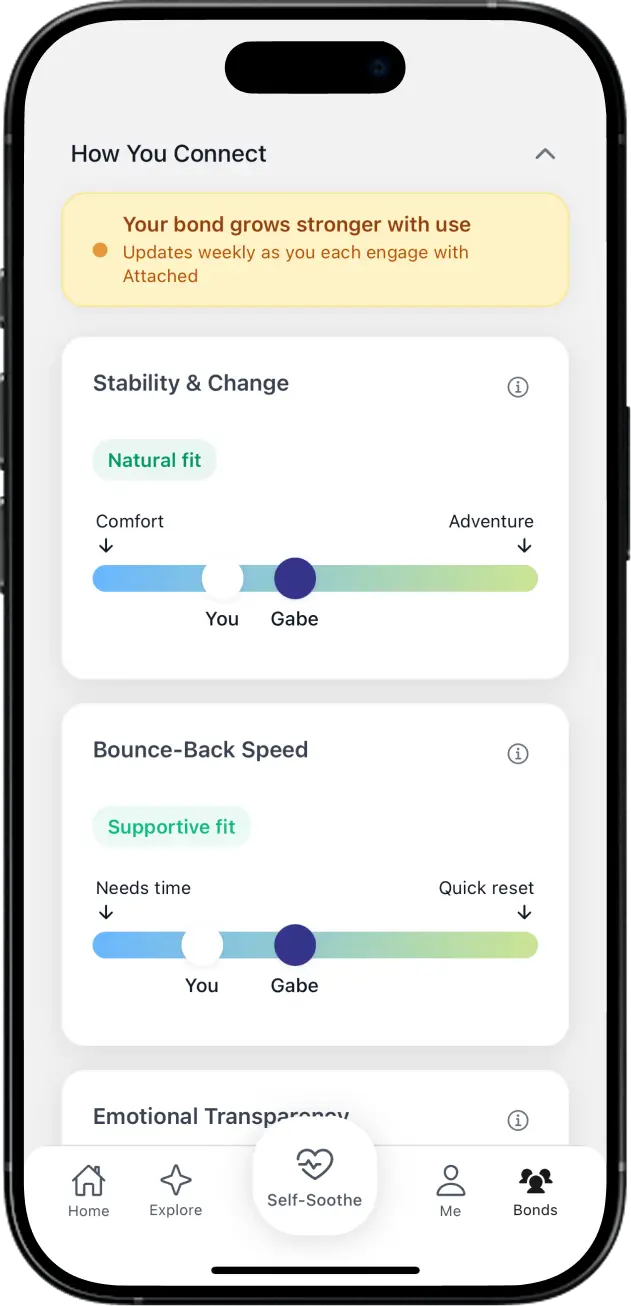
Finde heute deinen Bindungsstil heraus. Entdecke deinen Beziehungsplan, allein oder mit Partner
Ängstliche Bindung: Anzeichen, Ursachen und erste Schritte zu mehr Sicherheit

Wenn Nähe sich knapp anfühlt
Du wünschst dir Nähe, aber sobald jemand Abstand nimmt, fühlst du Unsicherheit, Alarm oder Verlassenwerden.
Du möchtest Beruhigung, aber selbst wenn du sie bekommst, beginnt dein Kopf schon, die nächste Distanz zu fürchten.
So fühlt sich ängstliche Bindung oft an.
Was ist ängstliche Bindung?
Ängstliche Bindung, auch ängstlich-preoccupied genannt, ist ein unsicherer Bindungsstil. Er entsteht oft dann, wenn Bezugspersonen in der Kindheit mal nah und zugewandt, dann wieder unberechenbar oder entfernt waren.
Die Kernerfahrung ist:
- Du brauchst viel Nähe, um dich sicher zu fühlen.
- Distanz löst Angst aus.
- Unklarheit wird zu innerem Alarm.
Dein Nervensystem lernt, ständig nach Anzeichen von Rückzug oder Verlust zu suchen.
Typische Anzeichen bei Erwachsenen
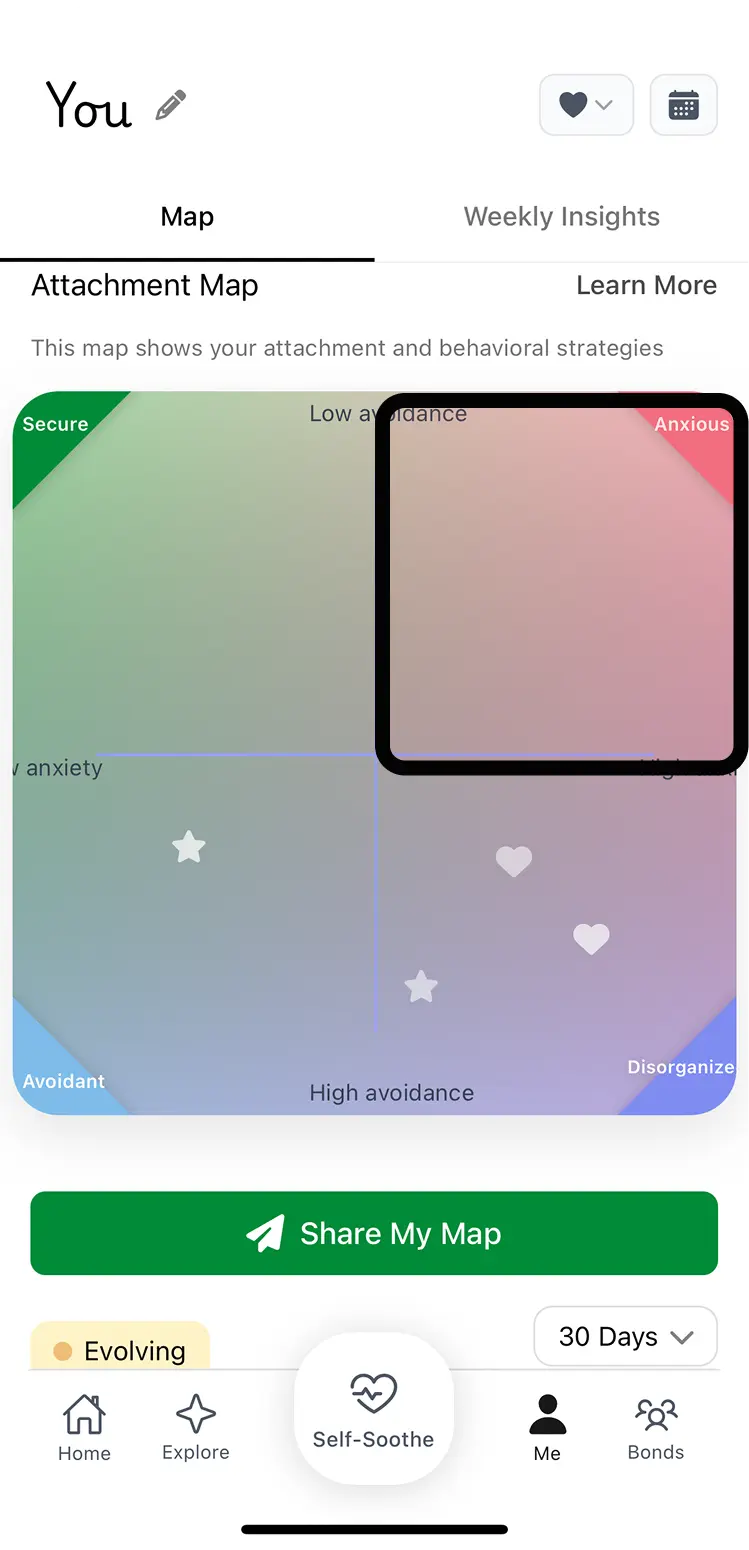
Anzeichen können sein:
- Du brauchst viel Bestätigung, um dich ruhig zu fühlen.
- Du interpretierst Nachrichten, Pausen oder Tonveränderungen schnell als Warnsignal.
- Es fällt dir schwer, dich zu regulieren, wenn dein Partner Raum braucht.
- Du suchst Nähe umso stärker, sobald du Distanz spürst.
- Ruhige Liebe fühlt sich ungewohnt an, intensive Liebe dagegen vertraut.
- Die Angst, verlassen oder ersetzt zu werden, ist sehr präsent.
Woher kommt das?
Viele Menschen entwickeln dieses Muster, wenn sie mit emotional unbeständigen Bezugspersonen aufgewachsen sind.
Der innere Lernsatz lautet dann oft:
"Damit ich geliebt werde, muss ich aufmerksam bleiben, mehr geben und Nähe absichern."
Deshalb können Beziehungen im Erwachsenenalter schnell überwältigend oder existenziell wirken.
Auch der Körper ist beteiligt
Ängstliche Bindung sitzt nicht nur im Denken. Sie zeigt sich auch im Körper.
Wenn deine Geschichte Distanz mit Gefahr verknüpft, reagiert dein Nervensystem mit Aktivierung:
- mehr Alarm
- mehr Dringlichkeit
- mehr Bedürfnis nach sofortiger Verbindung
Darum kann schon ein späteres Antworten oder ein kleiner Stimmungswechsel riesig wirken.
Ängstlich vs. andere Bindungsstile
| Bindungsstil | Zentrale Angst | Muster in Beziehungen | Regulation |
|---|---|---|---|
| Sicher | Geringe Verlustangst | Offen, stabil, vertrauensvoll | Beruhigt sich und kommuniziert |
| Ängstlich | Verlassenwerden | Sucht Nähe und Bestätigung | Hyperaktivierung |
| Vermeidend | Vereinnahmung | Zieht sich zurück | Deaktivierung |
| Desorganisiert | Nähe und Verlust zugleich | Push-Pull und Intensität | Wechsel zwischen beidem |
Wie es sich in Beziehungen zeigt
In Beziehungen kann ängstliche Bindung so aussehen:
- häufiges Bedürfnis nach Rückversicherung
- starke Reaktionen auf kleine Distanzsignale
- Schwierigkeiten, dem Gegenüber echte Eigenständigkeit zuzugestehen
- emotionale Achterbahn zwischen Hoffnung und Angst
Das bedeutet nicht, dass du „zu viel“ bist. Es bedeutet, dass dein System Sicherheit über Nähe im Außen sucht.
Wie mehr Sicherheit beginnen kann
Veränderung beginnt dann, wenn Sicherheit nicht mehr nur von außen kommen muss.
-
Benenne, was du fühlst.
"Ich bin aktiviert", "ich habe Angst", "ich fühle mich unsicher" schafft mehr Ruhe als impulsives Reagieren. -
Hilf deinem Körper, wieder runterzufahren.
Langsames Atmen, Grounding und Pausen helfen, wenn die Spirale hochgeht. -
Werde für dich selbst verlässlich.
Journaling, Selbstberuhigung und kleine eingehaltene Zusagen bauen innere Sicherheit auf. -
Übe, Distanz auszuhalten, ohne zusammenzubrechen.
Nicht jede Distanz ist Ablehnung. Manchmal ist sie einfach nur Raum. -
Such dir bindungsorientierte Unterstützung.
Therapie, somatische Arbeit und gute Tools können den Prozess stark beschleunigen.
Die Attached App bietet Übungen, Tools und begleitete Schritte, um von Angst zu mehr innerer Sicherheit zu kommen.
FAQ
FAQ
Do I have to be in a relationship to use this app? Can I use it alone?
Who's Eden the relationship coach from Attached?
I've tried talk therapy before but it hasn't helped, how is Attached any different?
- Online talk therapy: Many online therapists on general platforms may not specialize in attachment-based issues.
- Attached: Built around attachment patterns, guided reflection, and relationship habits, our tools help you notice the patterns behind relationship stress and practice different responses.
- Online talk therapy: Many platforms match you randomly with a therapist who may not have deep attachment expertise.
- Attached: Backed by experts in attachment; we designed the app around relationship reflection, attachment education, and daily practice.
- Online talk therapy: Providers may not remember every detail between sessions.
- Attached: Eden remembers and adapts to your journey.
- Online talk therapy: Limited hours of availability.
- Attached: 24/7 access so you can manage triggers and exercises anytime.
How is Attached different to ChatGPT?
- ChatGPT: General purpose AI assistant.
- Attached: Built for attachment patterns, self-reflection, and relationship habits.
- ChatGPT: Answers general inquiries.
- Attached: Uses psychology-informed prompts to help you reflect, slow down, and choose your next step.
- Bite-sized lessons based on relationship science
- Eden, your coach, grounded in relationship psychology
- Personalized meditations
- Accountability via gamification
How is attachment related to my interpersonal problems?
Does this still help if I'm currently in therapy?
Do I need to give a credit card to start the trial?
Is my data safe?
Can I use Attached for all attachment styles?
I don't have insecure attachment. Can I use Attached for general wellness?
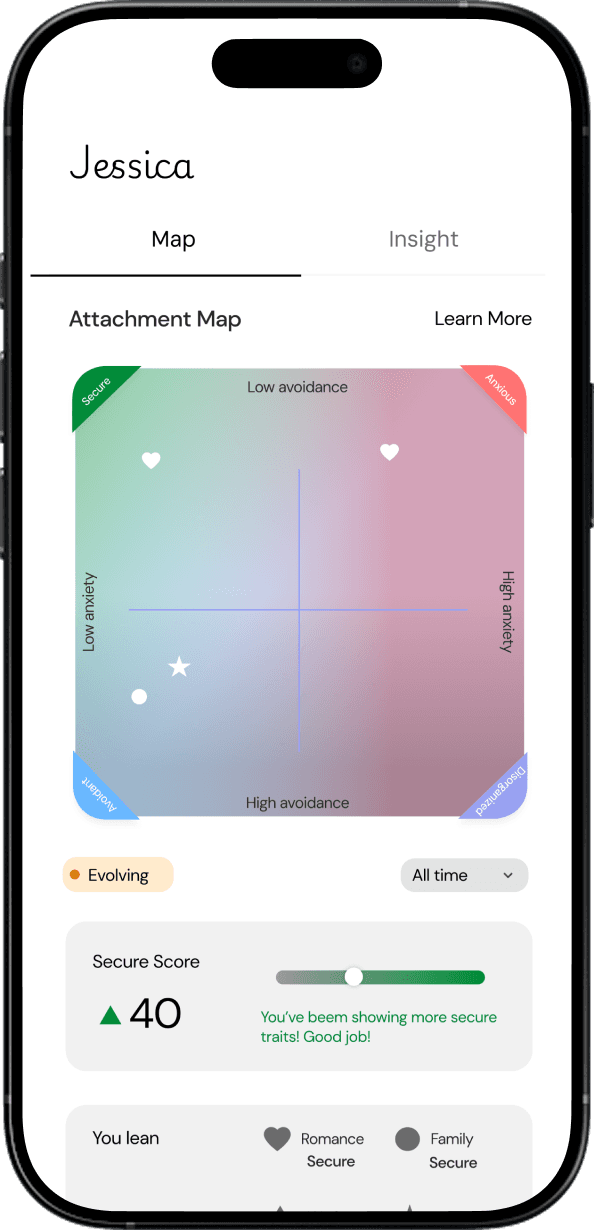
Discover your attachment style now and get a personalized plan
Attached is changing thousands of lives
Even in therapy, I struggled to be fully honest, mostly out of embarrassment over irrational thoughts. But this app made it safe. The app's slow, intentional pacing helped me absorb the lessons and reflect on how they apply to my life. The Trigger Cards were a game-changer—custom to my real triggers and guide me in the moment. I've started recognizing how my anxious attachment shows up and blocks me from fully experiencing love.
I'm very grateful for this app as it has been helping me understand myself and my patterns, encouraging growth through self-compassionate journaling, reflection, and habit tracking. My favorite part is the personalized meditations created uniquely for me.
After my divorce and the death of my best friend and mother, I struggled to adapt. I've been in therapy for years and this app is an incredible tool to help me practice the things my therapist recommends. The journaling tool reframes thoughts using AI, and the meditation feature guides acceptance, breathing, and grounding techniques.
This app is beyond helpful. It simplifies your journey through lessons, guided meditations, and journal prompts. It keeps you on track and maps your progress. It's worth the investment and I'm so glad I found it!
Even in therapy, I struggled to be fully honest, mostly out of embarrassment over irrational thoughts. But this app made it safe. The app's slow, intentional pacing helped me absorb the lessons and reflect on how they apply to my life. The Trigger Cards were a game-changer—custom to my real triggers and guide me in the moment. I've started recognizing how my anxious attachment shows up and blocks me from fully experiencing love.
I'm very grateful for this app as it has been helping me understand myself and my patterns, encouraging growth through self-compassionate journaling, reflection, and habit tracking. My favorite part is the personalized meditations created uniquely for me.
After my divorce and the death of my best friend and mother, I struggled to adapt. I've been in therapy for years and this app is an incredible tool to help me practice the things my therapist recommends. The journaling tool reframes thoughts using AI, and the meditation feature guides acceptance, breathing, and grounding techniques.
This app is beyond helpful. It simplifies your journey through lessons, guided meditations, and journal prompts. It keeps you on track and maps your progress. It's worth the investment and I'm so glad I found it!
Start with a free week on us, no credit card needed.
After free week
What could cost you $7,600/year is now $156/year
No credit card to start
FAQ
Do I have to be in a relationship to use this app? Can I use it alone?
Who's Eden the relationship coach from Attached?
I've tried talk therapy before but it hasn't helped, how is Attached any different?
- Online talk therapy: Many online therapists on general platforms may not specialize in attachment-based issues.
- Attached: Built around attachment patterns, guided reflection, and relationship habits, our tools help you notice the patterns behind relationship stress and practice different responses.
- Online talk therapy: Many platforms match you randomly with a therapist who may not have deep attachment expertise.
- Attached: Backed by experts in attachment; we designed the app around relationship reflection, attachment education, and daily practice.
- Online talk therapy: Providers may not remember every detail between sessions.
- Attached: Eden remembers and adapts to your journey.
- Online talk therapy: Limited hours of availability.
- Attached: 24/7 access so you can manage triggers and exercises anytime.
How is Attached different to ChatGPT?
- ChatGPT: General purpose AI assistant.
- Attached: Built for attachment patterns, self-reflection, and relationship habits.
- ChatGPT: Answers general inquiries.
- Attached: Uses psychology-informed prompts to help you reflect, slow down, and choose your next step.
- Bite-sized lessons based on relationship science
- Eden, your coach, grounded in relationship psychology
- Personalized meditations
- Accountability via gamification