Why You Can’t Fix Him / Avoidants (and Why You Keep Trying Anyway)

You can’t fix someone who’s afraid of being seen. But that’s not where the story ends.
Because I wish someone told me... the real question isn’t why they won’t change, it’s why you keep trying.
The Caretaker Pattern
If you always end up loving the person who doesn’t love you back the same way, that’s not bad luck. That’s conditioning.
Caretakers, often people with anxious attachment, grew up learning that love means earning connection. They become hyper-attuned to other people’s moods. They fix. They rescue. They soften their edges to keep the peace.
It’s survival for them. Somewhere deep inside, their nervous system believes: If I can just help you heal, you’ll finally stay.
So when they meet an avoidant, someone who’s emotionally distant, self-contained, allergic to vulnerability... it feels magnetic. Because it feels familiar.
You sense their walls and think, Maybe this time, I can love them enough to make them safe.
That’s the trap.
The Psychology of Wanting to Fix Others
Caretaking activates dopamine, the brain’s reward chemical, just like gambling or social media. Each small moment of closeness feels like a win. Each withdrawal feels like withdrawal.
Psychologists call this intermittent reinforcement: unpredictable affection that trains you to crave more. (Ferster & Skinner, 1957)
It’s literally chemical.
You keep trying to fix them because the trying itself becomes addictive. It gives you purpose. It protects you from facing your own fear: What if I stop trying… and there’s nothing left?
Why You Can’t Fix Avoidants
Avoidants pull away to manage fear. When love feels too close, their brain triggers a stress response: flight mode. The more you chase, the more they retreat. The more you fix, the more they feel broken.
That’s the issue: your attempts to prove safety remind them of danger.
You can model calm. You can express empathy. You can communicate clearly. But you can’t outlove someone’s defense system.
Healing has to come from the inside, from their own willingness to sit with discomfort instead of escaping it.
You can inspire growth. You can’t force it.
Looking Deeper: Why You Want to Fix Them
Ask yourself:
-
What part of me feels safer when I’m the healer?
-
What am I avoiding by focusing on fixing them?
-
Who would I be if I stopped earning love and started receiving it?
Because sometimes, fixing others keeps you from feeling your own pain. Caretaking can be a distraction from the grief of never being cared for the same way.
You don’t need to be the rescuer to deserve love. You just need to be real, messy, human, enough.
If you want to fix them...
You can’t heal someone by losing yourself. You can only heal by choosing yourself.
Love doesn’t mean pulling people out of their patterns. It means walking beside them while you both learn to stay present through your own.
The app to help you stop fixing others, and start healing yourself
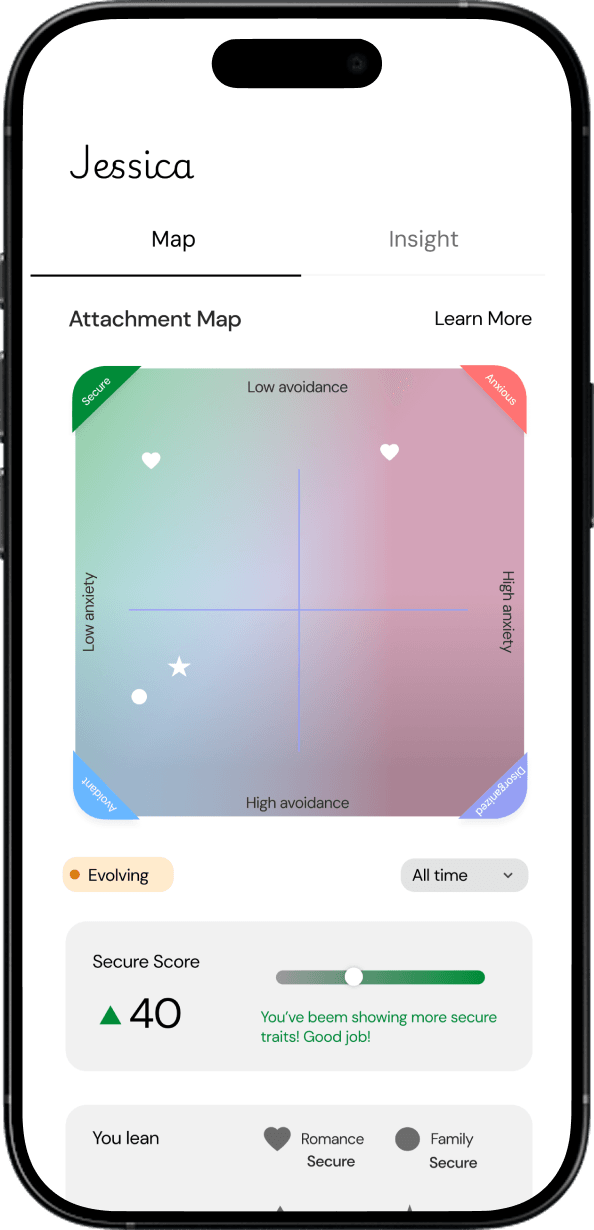
Love shouldn’t feel like a project. The No.1 app to help you explore your attachment style, understand your triggers, and stop repeating anxious-caretaker patterns in love.
The Attached app helps make this process easier with: • Daily Exercises to build emotional boundaries • Self-Soothe Mode for moments you feel responsible for others • Journal to uncover your caretaker habits • Weekly insights from Eden, your relationship guide
Download Attached for free and learn to create love that’s mutual, not managerial.
References:
• Bowlby, J. (1969). Attachment and Loss. • Mikulincer, M., & Shaver, P. R. (2007). Attachment in Adulthood. • Ferster, C. B., & Skinner, B. F. (1957). Schedules of Reinforcement. • Levine, A., & Heller, R. (2010). Attached.

Related articles
More reading to help this topic connect across the blog.
Why Avoidants Are Attracted to Anxious Partners (According to Attachment Theory) Your brain doesn’t care if love feels safe or not.
What if Taylor Swift’s “type” didn’t change by accident… but because of something else? And why Travis Kelce might be different to the rest.
What Avoidants Actually Want in a Relationship (According to Attachment Theory) Avoidants want love.
But not through pressure, persuasion, or panic. Avoidants change through safety. I used to think avoidants were hopeless. That they’d never open up.
Understand your attachment style
Read the full guide to each attachment style, or take the quiz to find yours.