7-Day Relationship Reset Challenge to Reconnect and Feel Closer Again

Okay so. This Valentine’s Day, it’s time to try something different.
Cause refined sugar is so last year!
I present to you, a 7-day experiment.
Each day is a small, science-backed challenges to deepen your bond this Valentine’s Day.
This challenge will change your relationship, forever.
How to use this 7-day challenge
- Do it the week leading up to Valentine’s Day
- Set aside ~20 minutes each day. Put your phones away!
- Read the prompt out loud
- Answer honestly
Day 1. This is where we are
Goal: Name the state of your bond without blaming. Build awareness.
The psychology:
Secure partners can talk about relationship problems without attacking the other person’s character. Especially by being curious, instead of defensive.
Challenge:
Sit facing each other. Take turns answering:
- “If I describe our relationship in one word right now, it’s ____.”
- “Lately, I feel closest to you when…”
- “Lately, I feel furthest from you when…”
Rules:
- Use “I” statements.
- No interrupting.
- No fixing yet. Just listen.
Attachment styles in this exercise:
- Anxious partner: practice slowing down and staying with your feelings, not jumping to “I just need more from you or you’ll leave.”
- Avoidant partner: practice staying in the conversation even when you want to exit. You don’t have to solve, just stay.
- Secure partner: model warmth and curiosity.
You’re practicing: We can look at us without running away
Day 2. I see what you do
Goal: Increase felt appreciation.
The psychology:
Studies on gratitude exercises in couples show that when partners regularly express specific appreciation, they report higher intimacy and relationship satisfaction, and less negative conflict.
Challenge:
Each, write down three specific things you appreciated about the other in the last week:
- You brought me coffee while I was on that stressful call
- You rubbed my shoulders when I didn’t even ask
- You listened to me rant about my boss
- Then sit together and read them out loud.
- After each one, the other person only says:
- “Thank you. It feels good to hear that.”
Attachment styles in this exercise:
- Anxious attachment undervalues the good and scans for danger. This practice forces your brain to register evidence of care.
- Avoidant attachment downplays need, including the need to feel appreciated. Saying gratitude out loud gently exposes that need
Day 3. Here’s what I don’t usually say
Goal: Share something deeper than daily logistics.
The psychology:
Self-disclosure: the act of revealing personal thoughts and feelings - shows strong links to intimacy, love, and relationship satisfaction.
Daily self-disclosure with a partner also could lead to better sleep and well-being.
Challenge:
Set a timer for 10 minutes each, uninterrupted.
One person talks. The other listens.
Use one of these prompts:
- “Something I’ve been scared to tell you is…”
- “One story from my childhood that still lives in me is…”
- “The part of me I’m most afraid you’ll reject is…”
Listener’s job:
- Keep eye contact
- Reflect back one or two sentences: “I hear that you…”
- Ask: “Is there more?” (at least once)
Then switch
Attachment styles in this exercise:
- Anxious partner: practice sharing without demanding reassurance right away. Just letting your truth be
- Avoidant partner: practice letting yourself be known, which research shows is necessary for real intimacy, even if your instinct says ‘stay private’
You’re practicing: I can show you more of me… and you stay.
Day 4. The emotion under the fight
Goal: Turn one recurring conflict into closeness
The psychology:
Cognitive Behavioral Therapy (CBT) and attachment-based therapy helps couples move from blame to vulnerable sharing of core attachment needs.
Challenge:
Pick a small but recurring fight. Something like:
- Phone use at night.
- Being late.
- House chores.
Each of you fills in these sentences:
- “When you ___, the story I tell myself is ___.”
- “Underneath my anger, I actually feel ___.”
- “What I really need in that moment is ___.”
Example:
- “When you scroll on your phone in bed, the story I tell myself is that you’re bored of me.”
- “Underneath my anger, I actually feel replaced and uncool.”
- “What I really need is you to look at me for a moment and say ‘I want you here.’”
Take turns. See the emotion lying under the hard behavior.
Attachment styles in this exercise:
- Anxious attachment shows up as blame and protest: “Why don’t you care?!” Underneath is fear of abandonment.
- Avoidant attachment shows up as shutting down or withdrawing. Underneath is fear of being judged or swallowed.
When couples can express these core attachment fears and needs, they create new, more secure emotional patterns.
Day 5. We play again
Goal: Create a small adventure that shakes up your usual pattern.
The psychology:
Novel, shared activities increase relationship satisfaction and closeness because they create new positive associations with the partner and activate curiosity instead of criticism
Challenge:
Choose one new thing to do together:
- Try a new coffee place and swap your usual orders.
- Take a beginner dance class.
- Walk a new route and pretend you’re tourists.
- Cook a recipe neither of you has tried.
During the activity, ask each other:
- “What part of this feels fun to you?”
- “What part feels awkward?”
Attachment styles in this exercise:
- Anxious partner: don’t keep asking, “Are you having fun? Are you mad?” Instead, focus on being present.
- Avoidant partner: try not to detach into your head. Let yourself laugh, even if it feels silly.
Your body needs memories of “us having fun” to balance out “us arguing.”
Day 6. This is how I want to love you in the future
Goal: Create specific secure behaviors you want to practice together
The psychology:
Secure attachment is not just a feeling; it’s a pattern of behavior: responsiveness, reliability, and open communication
Challenge:
Individually, write answers to:
- “If our relationship felt more secure six months from now, I’d notice because I would be doing more of…”
- “…and you would be doing more of…”
- “One habit I want us to build is…”
Examples:
- I would be telling you when I feel jealous instead of stalking your ex on social media
- You would be texting me when you’re running late instead of going silent
- One habit I want us to build is a 10-minute nightly check-in
- Share your lists
- Pick one habit to experiment with for the next month.
Attachment styles in this exercise:
- Anxious partner: shift from protest behaviors (tests, silent treatment, over-texting) to asking directly for contact and reassurance.
- Avoidant partner: shift from distance behaviors (ghosting inside the relationship, sarcasm, staying vague) to clear, kind communication.
Day 7. I choose you, here
Goal: End the week with deliberate commitment
The psychology:
Consistent signals of commitment and responsiveness build security over time. Gratitude, self-disclosure, and repair all sit inside that.
Challenge:
-
Write a short love letter (5–10 sentences):
- Start with: “What this week showed me about us is…”
- Include one thing you’re proud of in yourself.
- Include one thing you’re proud of in your partner.
- End with: “One way I want to keep choosing you is…”
-
Read the letters out loud.
Sit close and hold hands
Take a breather after each letter.
-
Create a small ritual to carry forward.
- Every Sunday, you exchange one thing you’re grateful for (Day 2).
- Every Wednesday, you do a 10-minute feelings check-in (Day 1/3).
- Every month, you pick a novelty date (Day 5).
You’re telling your system: “This didn’t end after seven days. We keep going.”
If you have an anxious attachment style…
I want to speak to you directly for a second.
You might feel like this whole challenge is a test.
“If they don’t do it, it means they don’t love me.”
That is your insecurity talking! It learned this script long before this partner. It’s normal for anxious attachment to have hyper-vigilance to signs of rejection and strong fear of abandonment.
So during this week:
- Treat each exercise as data, not a conclusion
- Notice small moves: eye contact, a softer tone
- When you fear, try saying out loud: “I feel scared you’ll leave, and I’m trying something new instead of shutting down.”
You are not too much
If you have an avoidant attachment style…
You might think now: “Man... This is… a lot.”
You might feel annoyed at the idea of talking this much.
Avoidant attachment builds on early experiences where closeness felt unreliable or overwhelming. The safest move was to handle everything alone.
So during this week:
- Think of each exercise as strength training, not exposure to danger.
- You get to set boundaries: “I can talk about this for 10 minutes, then I need a break.”
- When you feel like bolting, try saying: “I feel crowded right now, but I also care about us. Can we slow down instead of stop?”
Science and Psychology-backed Challenge
This challenge is based on attachment theory.
Studies show: secure partners tend to have higher relationship satisfaction, more trust, and better problem-solving.
Insecure attachment styles link to more conflict, more jealousy, and more breakup risk.
But your attachment style does not last forever!
Using an attachment app to keep going (beyond Valentine’s Day)
A 7-day challenge can open the door.
But long-term change needs repetition.
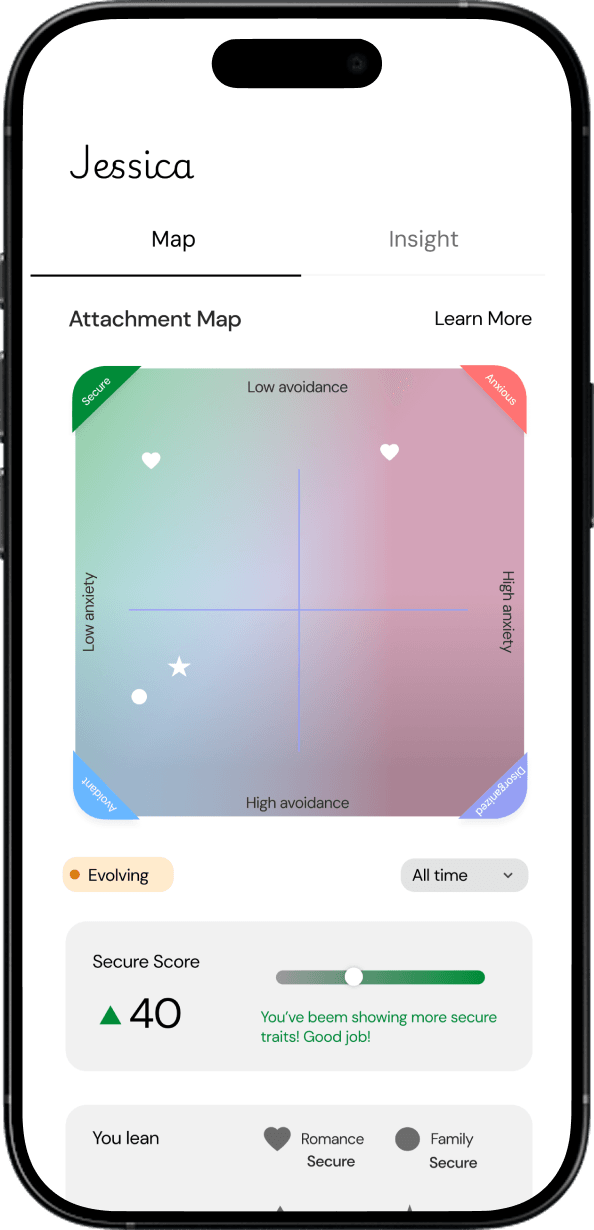
This is where a relationship app actually helps. The Attached app can walk you through daily practices that turn secure attachment from a concept into a habit.
You can:
- Daily Exercises for habit-building (gratitude, self-disclosure, repair scripts)
- Self-Soothe Mode for tough emotional moments when your attachment style goes into alarm
- Journal to find hidden emotional and relational patterns over time
- Weekly insights from Eden, your relationship guide, translating attachment science into real-life steps
Download Attached for free and start working toward security
Related reading
Related articles
More reading to help this topic connect across the blog.
Sick and tired of being clingy, overthinking your relationships (aka, anxious attachment), and always being the 'demanding' one? Introducing a new challenge to help you change, finally.
You can sit across from your partner, share dessert, kiss for a photo… and still feel alone. These 10 questions help you fall in love, again.
What if, you've never been in love before? Here are 7 signs you've never felt real, genuine love.
If someone you love always has their headphones in, this story will help you see what they’re actually running from, and what you can do about it.
Understand your attachment style
Read the full guide to each attachment style, or take the quiz to find yours.