Why Do I Get Jealous When My Partner Is With Other People? (And How to Stop)

Why Do I Get Jealous When My Partner Is With Other People? (And How to Stop)
If you get jealous whenever your partner is with other people, the short answer is: your attachment system is treating their attention to someone else as a threat of losing them — even when nothing is actually wrong. It's not a character flaw, and you can retrain it.
You trust them. You know they love you. But then they go out with their friends, or you catch yourself wondering, 'Why do I get jealous when my boyfriend talks to another girl?', and suddenly you start to feel anxious again.
Your chest tightens. Your mind starts racing. You tell yourself it's nothing, but your nervous system has already decided: this is a threat.
If this sounds familiar, you're not crazy. You're not "too much." What you're experiencing has a name, and it starts with how your brain learned to love.
Jealousy is just your system feeling threatened
When you feel jealous, your brain isn't just being dramatic. It thinks it's protecting you.
Jealousy is your mind saying:
"Alert! You might lose them."
This emotion often has deeper fears linked to it, like being abandoned, replaced, or forgotten. If you grew up feeling emotionally unsafe, unseen, or not good enough, your body now reacts to small things as if they're huge threats.
The craziest thing is, your body has been trained to think that your life is in danger, that's why you feel so anxious by it.
So when your partner gives attention to someone else—even casually—your nervous system sounds the alarm. And it feels like a full-on emergency, even if nothing's actually wrong.
What attachment styles has to do with it
If you have anxious attachment, jealousy hits harder.
Here's why:
- You constantly worry about losing connection.
- You fear being "not enough" or "too much."
- You need frequent reassurance to feel secure.
Your brain has learned that love might disappear at any moment. So when your partner bonds with someone else, even for a second, it feels like you're about to be left behind.
This tracks with the research. In a study of 847 adults, higher attachment anxiety predicted more romantic jealousy (Richter et al., 2022), and attachment anxiety specifically predicts the intrusive, looping thoughts that make jealousy so hard to switch off (Chursina, 2023).
Meanwhile, people with secure attachment might still feel jealous, but they don't spiral. They trust the bond, even when attention shifts temporarily.
Do Avoidants Get Jealous?
Since we're exploring attachment styles, you might be wondering: do avoidants get jealous too?
The short answer is yes. However, avoidant attachment jealousy looks completely different from anxious jealousy. While someone with anxious attachment might seek reassurance or get visibly upset, an avoidant partner usually suppresses the feeling. When they feel threatened by someone else getting your attention, their nervous system tells them to retreat. They might shut down, become overly logical, or pull away entirely. They feel the sting of jealousy, but they handle it by creating distance instead of clinging. Research lines up with this quieter pattern: jealous thoughts and behaviors are tied most strongly to attachment anxiety, while higher avoidance is linked to fewer open, behavioral expressions of jealousy (Chursina, 2023).
What triggers it?
You might notice jealousy flare up when:
- Your partner is texting someone else.
- They're giving someone else attention in public.
- They talk about a "funny coworker" too many times.
- You're not included or prioritized.
But it's not just them. These moments often poke old wounds:
- A parent who was emotionally unavailable
- Being cheated on in the past
- Feeling invisible growing up
Jealousy is your body remembering what it's like to feel left out, and begging not to feel that again.
Trying to bury it doesn't work
You might try to ignore it or feel guilty about it.
"I shouldn't feel this way."
"I'm just being dramatic."
But pushing jealousy down doesn't make it go away. It just makes it louder, more confusing, and harder to talk about.
Jealousy isn't something to fight. It's something to listen to.
What you can do instead
Here's how to work with jealousy gently:
1. Name the anxious jealousy
Instead of saying "I'm just being stupid," say:
"I feel jealous, and I think it's because I'm scared of being replaced."
2. Soothe your nervous system
Tell your body that you're actually safe.
Try grounding techniques:
- Box breathing (inhale 4, hold 4, exhale 4, hold 4)
- Place a hand on your chest and say: "I'm safe right now."
- Journal what triggered you—and what you actually needed in that moment.
3. Talk to your partner with vulnerability
Don't say, "Why were you flirting?"
Instead: "When I saw that, I felt really anxious. Can you remind me that I'm important to you?"
4. Build internal safety
The more secure you feel inside, the less power jealousy has.
- Affirmations: "I am worthy, even when others are present."
- Therapy, journaling, or using apps like Attached can help untangle your patterns.
You are not toxic or broken
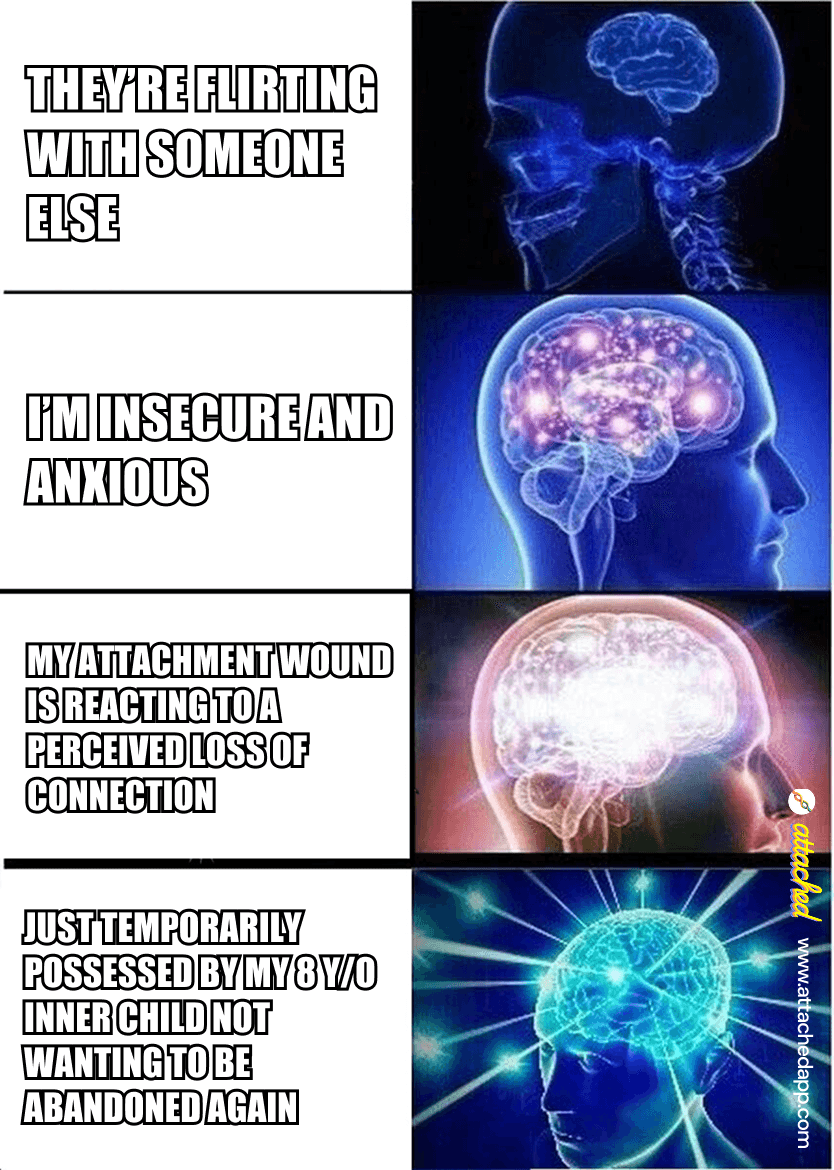
If you get jealous when your partner is with others, it means a younger part of you still needs safety, love, and reassurance.
Jealousy isn't the problem. It's the message.
And when you learn how to listen with compassion, it becomes your guide back to emotional peace.
If you're tired of this feeling
If you're tired of this feeling, it's not because you're broken. It's because your brain got used to perceiving a lack of connection as threat. But the good news is, you can rewire your patterns and start feeling safe, seen, and calm.
The Attached app helps make this process easier with:
- Daily Quests for habit-building
- Help Mode for tough emotional moments
- Guided Journal to find hidden emotional patterns
- Weekly Coaching from Eden, your relationship guide
Download Attached for free and start feeling more free.
Frequently asked questions
Why do I get so jealous in my relationship?
Often because an anxious attachment style primes you to fear abandonment, so a partner's attention elsewhere triggers a threat response and a strong need for reassurance.
Is jealousy a sign of anxious attachment?
Frequent, intense jealousy that's hard to soothe is a common anxious-attachment pattern, though it can have other causes too, such as past betrayal or low self-worth.
How do I stop being jealous and insecure?
Build internal security: notice the trigger, self-soothe before reacting, communicate your needs calmly instead of monitoring your partner, and work on the underlying attachment pattern over time.
Related articles
More reading to help this topic connect across the blog.
She did it. After all those breakup songs, Taylor Swift found her true love.
Anxious-avoidant attachment is the draining loop where one person reaches for closeness and the other reaches for space, and each move makes the other's fear worse. This guide covers the psychology behind it and what actually helps you change it.
What if, you've never been in love before? Here are 7 signs you've never felt real, genuine love.
What if your Valentine’s gift didn’t just say “I love you,” but also improved your relationship for the long-run? These 13 therapist-approved picks do more for your relationship than any heart-shaped box ever will.
Understand your attachment style
Read the full guide to each attachment style, or take the quiz to find yours.